
Real Estate Lead Generation: The Google Ads + Landing Page Stack That Books Showings

Real estate lead generation through Google Ads delivers qualified prospects at roughly $20-60 per buyer lead and $150-400 per seller lead (Jamil Academy) when you connect search intent to targeted landing pages with proper tracking. Most agents pay $139-223 per Zillow Premier Agent connection based on Zillow’s published rates, and those leads are shared with competing agents in the same ZIP code under Zillow’s market-share model. Google Ads with dedicated landing pages give you exclusive access to buyers and sellers actively searching for properties or agents in your market.
The key to driving high-intent traffic that books showings is matching Google Ads campaigns to specific landing pages that address searcher intent. A “first-time homebuyer Denver” search should land on a page about the first-time buyer process in Denver, not your generic homepage. Combined with call tracking — since most real estate leads prefer phone contact over form fills — this stack lets you optimize campaigns based on actual showings booked, not just form submissions — and our small-business Google Ads walkthrough covers the campaign setup those optimizations depend on.
Real estate Google Ads average around $2.53 per click, and a well-targeted landing page converts visitors to leads in the low-to-mid single digits — with real-estate pages specifically often running lower, which is why cost per lead varies so widely by market and targeting. But “conversion” here means lead captured, not deal closed. Internet real estate leads close at roughly 0.4-1.2% of total volume on average (Jamil Academy), with top producers reaching 3-5% through fast follow-up and disciplined nurturing.
Why Most Real Estate Lead Generation Approaches Underperform
Referral programs, social media, and lead aggregators underperform due to timing issues and shared prospect competition that reduces conversion rates. The three most common lead generation approaches each have structural limitations that cap their effectiveness.
Referral programs depend entirely on your existing network’s activity and timing. Even strong referral sources only generate 2-4 leads per month, and you can’t scale referrals on demand when you need to fill your pipeline quickly.
Social media marketing requires consistent content creation and typically generates interest from people not yet ready to buy or sell. The timeline from social engagement to transaction often spans 6-18 months, making it difficult to predict revenue or maintain consistent deal flow.
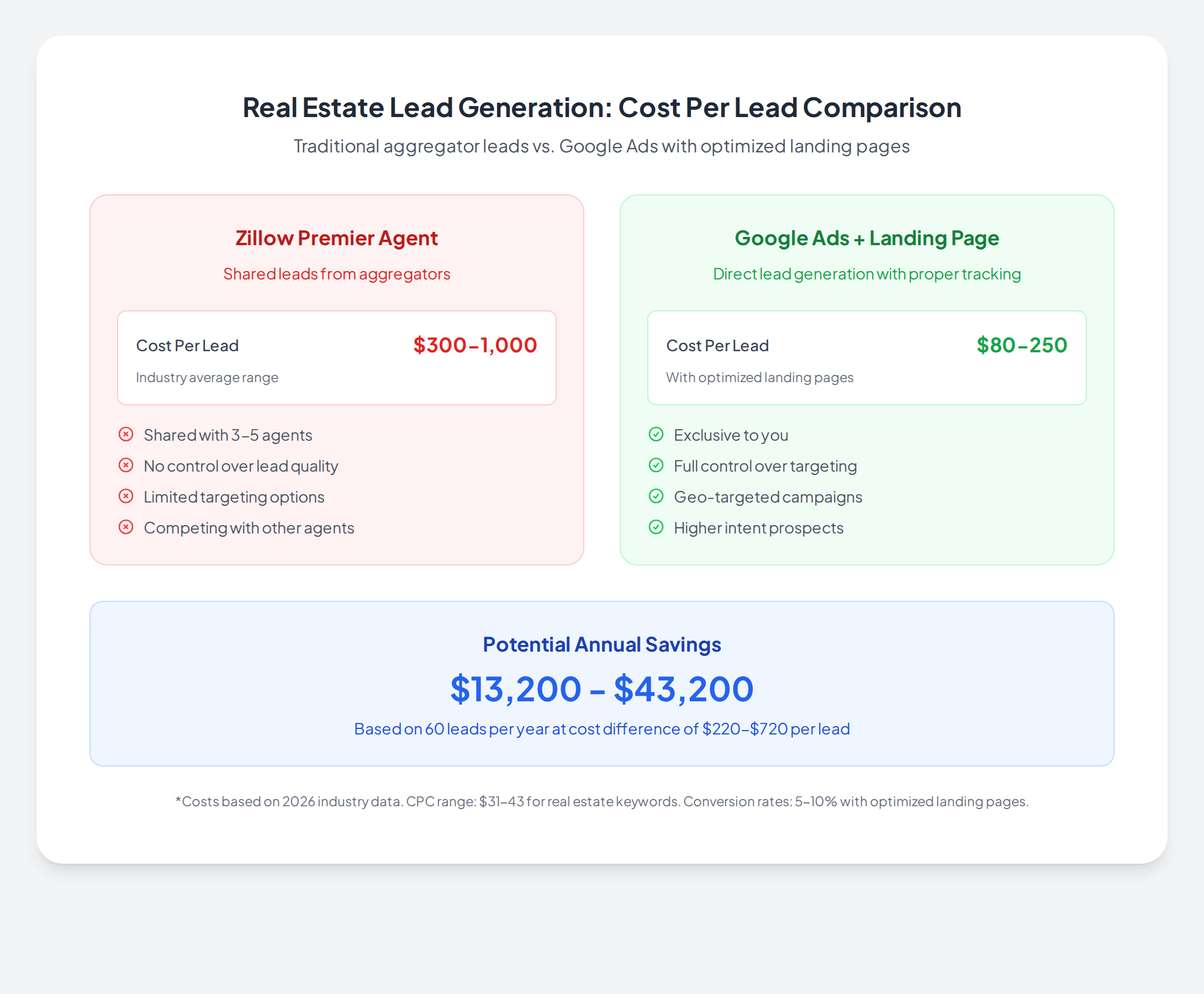
Lead aggregators like Zillow Premier Agent, Realtor.com, and HomeAdvisor charge $139-223 per connection — and routinely run $300-1,000+ per month in smaller markets, far more in competitive metros — but share those leads with competing agents in the same area. You’re paying premium prices to compete immediately with other agents for the same prospect’s attention. Conversion rates suffer because prospects receive multiple calls within minutes.
How Google Ads Beats Buying Leads From Aggregators
Google Ads deliver exclusive leads — roughly $20-60 per buyer lead and $150-400 per seller lead (Jamil Academy) — versus shared aggregator connections at $139-223 each, giving you first-contact advantage with motivated prospects. When someone searches “sell my house fast [your city]” or “homes for sale [neighborhood],” they’re expressing immediate intent to transact.
Aggregator leads come from broad property browsing on portals, then get distributed to multiple agents simultaneously. The prospect might have clicked a listing out of curiosity, not because they’re ready to transact. By the time you call, they’ve often forgotten they submitted a form.
Google Ads leads come from specific search queries that indicate transaction readiness. “Real estate agent near me,” “sell house without realtor,” or “first-time home buyer programs” represent active problem-solving behavior. The searcher lands directly on your targeted page and contacts you specifically.
The exclusivity advantage is significant. Aggregator leads typically connect with multiple agents within the first hour. Google Ads leads contact only you, giving you time to build rapport before competitors enter the picture.
Cost comparison favors Google Ads substantially:
- Zillow Premier Agent: $139-223 per connection (shared with competing agents)
- Realtor.com leads: comparable per-lead pricing, also shared
- Google Ads with optimized landing pages: roughly $20-60 per buyer lead and $150-400 per seller lead, exclusive to you (Jamil Academy)
The Landing Page Most Real Estate Sites Get Wrong
Most real estate Google Ads send traffic to generic home pages that convert poorly because they don’t match specific search intent, while neighborhood or property-type landing pages convert 3-5x better. The homepage trap catches 80% of agents running Google Ads.
A searcher looking for “Boulder condos for sale” doesn’t want to see your bio, recent sales, and service overview. They want Boulder condo listings, neighborhood information, pricing trends, and market insights specific to Boulder condominiums. Your homepage serves your brand; specialized landing pages serve their intent.
High-converting real estate landing pages focus on:
Geographic specificity: “Downtown Denver Lofts” performs better than “Denver Real Estate” because it matches precise location interest. Include neighborhood boundaries, school districts, commute times, and local amenities.
Property type alignment: “Luxury homes,” “first-time buyer properties,” “investment properties,” and “senior-friendly homes” each attract different prospects with different needs and timelines.
Process education: First-time buyers need mortgage pre-approval guidance. Luxury sellers want market positioning strategy. Investment buyers focus on cash flow analysis. Match your page content to their knowledge gaps.
Local market data: Include recent sales, average days on market, price trends, and inventory levels for the specific area or property type. This positions you as the local market expert.
The conversion rate difference is substantial. Generic homepage conversion rates run especially low for cold Google Ads traffic. Targeted landing pages with relevant content and clear calls-to-action convert in the low-to-mid single digits — real-estate pages specifically often run lower — because they directly address what brought the searcher to Google in the first place.
Tracking Real Estate Conversions Properly
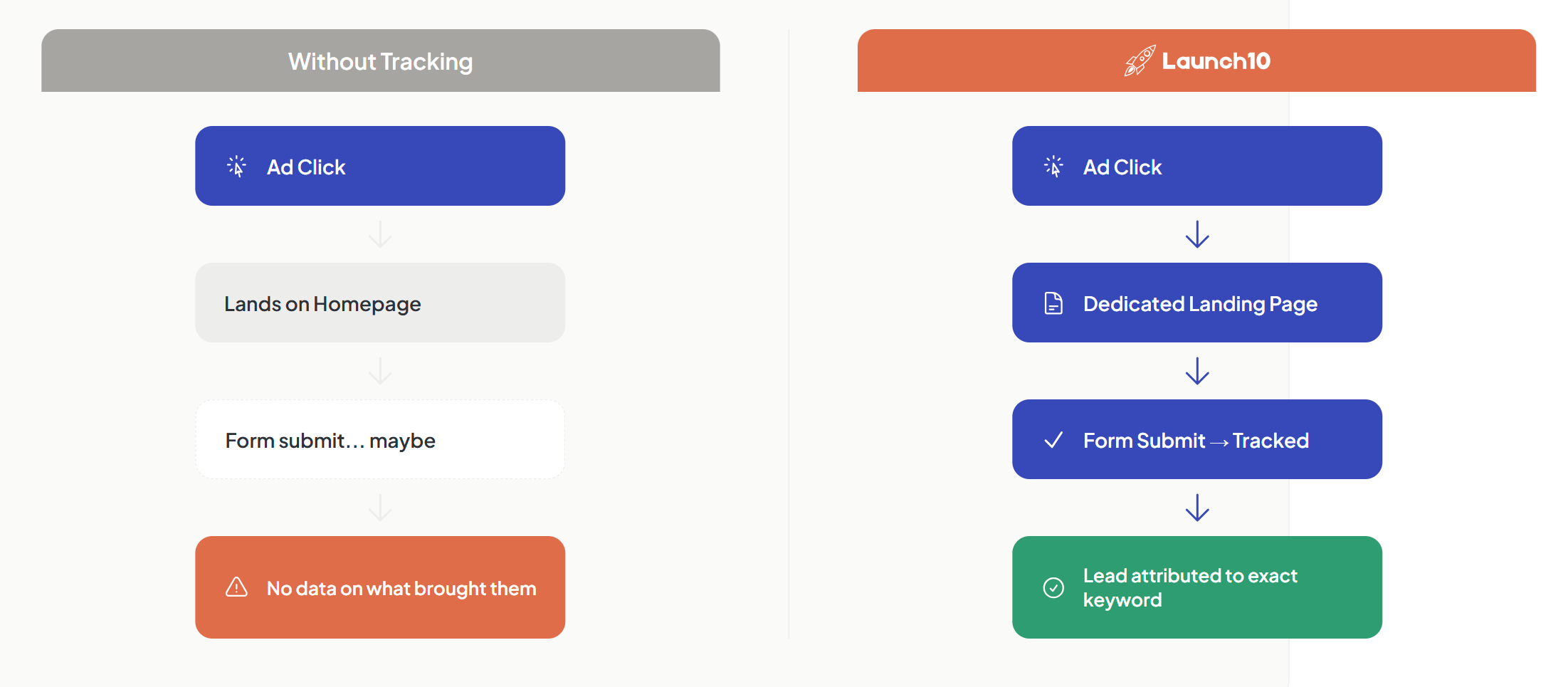
Phone tracking integration is essential for real estate because most leads prefer calling over form submission, making call attribution critical for campaign optimization. Most agents lose this data and can’t identify which campaigns generate actual showings.
Standard Google Ads conversion tracking only captures form submissions, missing the majority of real estate leads who pick up the phone. Without call tracking, you’re optimizing campaigns based on a fraction of your actual lead volume, leading to poor budget allocation decisions.
Effective real estate conversion tracking requires:
Dynamic phone number insertion: Each Google Ads campaign gets a unique tracking number that forwards to your main line. This lets you identify which campaigns and keywords drive phone leads, not just form leads.
Call recording and qualification: Not every call is a qualified lead. Track call duration, conversation outcome, and lead quality to optimize for valuable contacts, not just call volume.
Offline conversion tracking: Connect lead capture to actual showings and closed deals through your CRM. Import this data back into Google Ads so the algorithm optimizes for revenue, not just lead volume.
Attribution across touchpoints: Real estate buyers often research online, call for information, schedule a showing, then continue researching before making offers. Track the full customer journey to understand true campaign impact.
The tracking setup connects your CRM data back to Google Ads through offline conversion imports. When a lead from your “Boulder buyers” campaign closes a deal six months later, Google Ads learns to find more prospects similar to that successful lead.
Building the Real Estate Google Ads + Landing Page + Tracking Stack
Launch10 is purpose-built AI for Google Ads that builds the geo-targeted landing page, the campaign structure, and the conversion tracking as one workflow — letting agents launch complete lead generation systems without coordinating multiple vendors.
Traditional setup requires stitching together a landing page builder, Google Ads account management, a call tracking service, and analytics integration. Each component needs separate configuration and ongoing optimization. The full workflow typically takes 2-3 weeks and requires technical knowledge most agents don’t have.
Launch10’s integrated approach means describing your target market — “luxury home buyers in Boulder” or “first-time buyers in North Denver” — and getting a complete campaign including:
Geo-targeted landing pages: A page built around the specific search intent of your target market — neighborhood, property type, or buyer segment — rather than a generic agent homepage.
Aligned Google Ads campaign: Keyword targeting, ad copy, and geographic parameters that match the landing page content, so the message stays consistent from search to contact.
Phone and form conversion tracking: Built in, with attribution back to the specific keyword and ad that drove each lead.
Lead routing via Zapier: Forms and call data connect to your CRM through Zapier, so your existing follow-up workflow keeps working.
An agent targeting luxury sellers in Cherry Creek can launch a Cherry-Creek-specific landing page with a matching “sell luxury home Cherry Creek” Google Ads campaign and call tracking attribution — all configured in one workflow rather than three separate setups.
A Practical Real Estate Lead-Gen Audit You Can Run Today
Start by auditing your current lead sources to identify conversion rate gaps and cost inefficiencies, then evaluate whether your Google Ads traffic matches your intended prospect profile.
1. Calculate your true cost per lead by source. Include all costs: Zillow Premier Agent monthly fees plus per-connection charges, social media ad spend divided by qualified leads generated, referral program incentives, and networking event costs. Most agents discover their blended cost per lead is far higher than they realized once every channel’s true cost is counted.
2. Track lead source to closing ratios. Different sources produce different close rates. Warm referrals convert to appointments at far higher rates than cold portal leads, which typically close at 1-3%. Your actual cost per closed deal reveals which sources drive profitable growth.
3. Audit your current landing pages. If you’re running Google Ads to your homepage, check your bounce rate (likely 60-80%). Create one test landing page specific to your highest-volume keyword and compare conversion rates over 30 days.
4. Review your Google Ads keyword match types. Broad match keywords in competitive real estate markets generate expensive, irrelevant traffic. Switch to phrase match and exact match for location and property-type terms to improve lead quality.
5. Implement basic call tracking. Use a forwarding number on your website and marketing materials for one month. Track which marketing activities drive phone leads versus form submissions. This reveals your actual lead volume and helps you optimize for total contacts, not just digital conversions.
The audit typically reveals that agents are paying 2-3x more per lead than they realize and missing 50-70% of their actual lead volume due to poor phone tracking. These insights guide better budget allocation and campaign optimization decisions.
Real estate lead generation through Google Ads requires connecting search intent to relevant landing pages with comprehensive tracking. The difference between an exclusive lead you own outright and a $139-223 shared connection often comes down to this integration — matching what people search for to what they find on your page, then tracking all contact methods to optimize for actual showings and closings. If you’d rather not assemble this stack yourself, see how Launch10 builds it as one workflow or check out pricing.
Related reading
- Connecting your landing page and ads — matching search intent to the page that converts it
- Google Ads conversion tracking setup — call and form attribution that reveals which campaigns book showings
- Why your Google Ads aren’t generating leads — diagnosing campaigns before blaming the channel
Frequently asked questions
How much do real estate Google Ads cost?
What's a good cost per lead for real estate?
Should real estate agents use Google Ads or Zillow?
What landing page works best for real estate ads?
How do I track which Google Ads campaigns produce closed deals?

Co-Founder & CEO, Launch10
Greg Hockenbrocht is the Co-Founder and CEO of Launch10. Before Launch10, he was on the executive leadership team at Fundera through its acquisition by NerdWallet, where he led Growth & New Ventures following the company's IPO. Through Illuminated Ventures and work with founders and business owners, he saw a need for Launch10 to help bring clarity, confidence, and ease to digital marketing.