Why Your Landing Page and Ads Should Be Connected

Your landing page and Google Ads should be connected because integrated campaigns convert 2-5x better than disconnected tools. When your ad copy, landing page, and conversion tracking share data, you get message match that lifts Quality Score, tracking that shows which ads produce customers, and a feedback loop that improves performance automatically.
The Fragmentation Problem: Why Most Small Business Campaigns Leak Money
Most businesses run Google Ads with one tool, host their landing page on another, and track conversions with a third — creating data gaps that make optimization impossible. Each tool works fine on its own. The problem is that none of them talk to each other — and the gaps between them are where your marketing budget disappears.
This is the fragmentation problem, and it is staggeringly common. A MarketingSherpa Landing Page Survey found that 44% of B2B companies direct clicks from ads, email, or search to their homepage instead of a dedicated landing page. Unbounce’s conversion benchmark data shows the median landing page converts at 6.6% across industries, while WordStream reports the top 10% of accounts convert at 11.45% or higher. The difference between average and top-performing pages is almost always the same: alignment between the ad, the page, and the tracking.
When your landing page and your ads are disconnected — different messaging, broken tracking, no feedback loop — you are paying full price for a system running at half capacity. This guide explains exactly what “connected” means, why it matters, and how to fix it.
44% of B2B companies send paid traffic to their homepage instead of a dedicated landing page. That single disconnect can sharply reduce conversions — turning a profitable campaign into a money pit before it even has a chance.
What “Connected” Actually Means
A connected campaign is one where your ad campaign, your landing page, and your tracking are built as parts of a single system. They share data, they reinforce each other, and changes to one automatically reflect in the others. Three things make a campaign connected: message match, shared data, and unified tracking.
Message Match
Message match means your ad copy and your landing page copy say the same thing. Not “roughly similar” — the same specific promise, the same language, the same offer. When someone searches “HVAC repair Phoenix” and clicks an ad that says “HVAC Repair in Phoenix — Same-Day Service, Licensed Technicians,” the landing page headline should echo that exact promise. Not “Welcome to Desert Comfort HVAC — Full-Service Heating and Cooling Solutions.” That mismatch costs you the click you already paid for.
Unbounce’s research consistently shows that strong message match increases conversion rates by more than 50%. That is not a marginal improvement. On a $3,000 monthly ad budget generating 50 leads, a 50% conversion rate increase means 25 additional leads per month — at zero additional ad spend. The cost per lead drops from $60 to $40 overnight.
Shared Data
In a connected system, your landing page knows which ad brought each visitor. Your ad platform knows which landing page variations convert best — which is exactly what makes A/B testing landing pages against ad spend meaningful instead of guesswork. Your analytics knows the full journey from search query to form submission. When tools are disconnected, this data lives in silos. You might know you got 200 clicks, but not which keywords drove the 15 that became customers. You might know your landing page converts at 5%, but not whether visitors from your “emergency repair” ad group convert differently than visitors from your “annual maintenance” ad group.
Unified Tracking
Conversion tracking is the technical bridge between your landing page and your ad campaign. When someone fills out a form on your landing page, a tracking event fires back to Google Ads, telling it “this click became a lead.” Without that signal, Google Ads cannot optimize toward conversions — it just optimizes toward clicks, which is a very different (and much less valuable) goal. End-to-end tracking materially improves campaign performance — WordStream’s analysis found that accounts with proper tracking and at least one negative keyword achieve conversion rates nearly 3x higher than those without (13% vs 4.6%). That improvement comes simply from giving the ad platform the data it needs to find more of your best customers.
Message Match: The Conversion Lever Most Businesses Ignore
Message match is the single most underutilized conversion optimization technique in small business advertising. It costs nothing extra to implement, it requires no technical skill, and its impact is immediate and measurable. Yet most businesses get it wrong because their tools make it hard to get right.
A Concrete Example
Consider a real scenario. A Phoenix home services company runs Google Ads for three services: AC repair, furnace installation, and duct cleaning. They have one landing page for all three services.
| Ad Headline | Landing Page Headline | Message Match? |
|---|---|---|
| ”Emergency AC Repair Phoenix — 24/7" | "Your Trusted HVAC Partner” | No |
| ”Furnace Installation — Free Estimates" | "Your Trusted HVAC Partner” | No |
| ”Air Duct Cleaning — $99 Special" | "Your Trusted HVAC Partner” | No |
The visitor who searched “emergency AC repair Phoenix” and clicked an ad promising exactly that arrives on a page that says nothing about emergencies, nothing about AC repair, and nothing about Phoenix. They have to scroll, hunt, and figure out if this company even offers what they need. Most will not bother — they will click back and try the next result. You just paid $6.55 (the average home services CPC per WordStream 2025) for nothing.
Now imagine three dedicated landing pages:
| Ad Headline | Landing Page Headline | Message Match? |
|---|---|---|
| ”Emergency AC Repair Phoenix — 24/7" | "Emergency AC Repair in Phoenix — Available 24/7” | Yes |
| ”Furnace Installation — Free Estimates" | "Professional Furnace Installation — Get Your Free Estimate” | Yes |
| ”Air Duct Cleaning — $99 Special" | "Air Duct Cleaning — Book Today for $99” | Yes |
Each page confirms the visitor is in the right place within two seconds. The headline matches what they clicked. The page content expands on that specific service. The call to action is specific (“Schedule Emergency Repair” vs. “Contact Us”). This is what converts at 11.45% instead of 5.89%.
Companies with 30+ landing pages generate 7x more leads than those with fewer than 10 (HubSpot). The reason is simple: more pages means more message match, which means more visitors who see exactly what they searched for.
Why Disconnected Tools Make This Hard
When your landing page builder and your ad platform are separate tools, maintaining message match is a manual, ongoing chore. You write the landing page in one tab. You write the ad copy in another. You try to keep them aligned from memory. Then next month, you update the landing page offer but forget to update the three ad variations that reference the old offer. Message match drifts, and conversion rates drop without any obvious cause.
This is not a discipline problem — it is a tooling problem. When the tools are separate, drift is inevitable. When the tools are connected, match is automatic. The difference shows up directly in your conversion rate and cost per lead.
The Quality Score Connection: How Your Landing Page Affects Ad Cost
Google does not just care about your bid when deciding where to show your ad and what to charge you. Google Ads Quality Score is a 1-10 rating based on three equally weighted factors: expected click-through rate, ad relevance, and landing page experience. That third factor — landing page experience — means Google literally evaluates your landing page every time your ad enters an auction, and getting Quality Score and landing page experience right is one of the biggest levers you have on your cost per click.
The financial impact is severe. An above-average Quality Score can meaningfully reduce your cost per click, while a below-average score can raise it sharply. On a $3,000 monthly budget, that is the difference between paying $2.00 per click (750 clicks/month) and paying $8.00 per click (375 clicks/month). Same budget, half the traffic, half the leads — all because your landing page did not match your ad.
Google evaluates landing page experience on several criteria: relevance to the ad and keyword, page load speed, mobile-friendliness, and ease of navigation. But relevance is the dominant factor. A page about “emergency AC repair in Phoenix” scores well against ads for “emergency AC repair Phoenix.” A generic “HVAC services” page scores poorly. For a deeper look at how Quality Score affects your Google Ads campaigns, see our full guide.
Conversion Tracking: The Feedback Loop You Cannot Afford to Break
Conversion tracking is what turns Google Ads from a cost center into a measurable channel — without it, you’re spending money with no way to know what’s working. It is the mechanism that tells Google Ads which clicks turned into leads, calls, or sales. Without it, you are flying blind — you know you spent money, and you know people clicked, but you have no idea which clicks mattered. This is not a nice-to-have analytics feature. It is the core feedback loop that makes paid advertising work.
What Happens Without Conversion Tracking
Without tracking, Google Ads optimizes for clicks. With tracking, it optimizes for conversions — the actual leads and sales you care about. These are fundamentally different objectives. Click optimization finds people who click ads. Conversion optimization finds people who click ads and then take action. The second group is dramatically more valuable, and Google’s algorithms are remarkably good at finding them — but only if you give them the conversion data to learn from.
Consider a practical example. You run two ad groups: “emergency plumber” and “plumbing tips.” Both get clicks. Without conversion tracking, Google sees them as equally valuable and splits your budget evenly. With tracking, Google sees that “emergency plumber” converts at 8% while “plumbing tips” converts at 0.5%. It automatically shifts budget toward the high-converting group. Over 30 days, this single optimization can double your lead volume at the same total spend.
The Technical Reality
Setting up conversion tracking correctly across separate tools is the step where most small businesses fail. It requires installing code snippets on your landing page, configuring conversion actions in Google Ads, making sure form submissions fire the right events, and verifying that data flows correctly between systems. Google Tag Manager helps, but it adds another tool to the stack. A large share of small business advertisers do not have proper conversion tracking — meaning a large share of all small business ad spend is untracked and unoptimized.
This is where the connected-system advantage is most obvious. When your landing page and ads are built together, tracking is configured at the same time as the page. There is nothing to install separately, no Tag Manager to configure, no code to paste. The tracking just works from day one.
The Data Loop: How Connected Systems Improve Over Time
A connected campaign does not just perform better on day one — it gets better over time through a data feedback loop. Here is how it works.
Your ads generate traffic. Your landing page converts some of that traffic into leads. Conversion tracking reports which ads, keywords, and audiences produced those leads. The ad platform uses that data to optimize future ad delivery. Better ad delivery means higher-quality traffic. Higher-quality traffic means better conversion rates. Better conversion data means even smarter optimization.
This loop is the reason well-optimized campaigns see improving performance over months, not declining performance. But the loop only works if every link in the chain is connected. Break the tracking link, and Google cannot optimize. Break the message match link, and conversion rates drop. Break the data flow, and you cannot identify what to improve. End-to-end tracking — the full connected loop — improves marketing ROI. That improvement compounds month over month as the system learns.
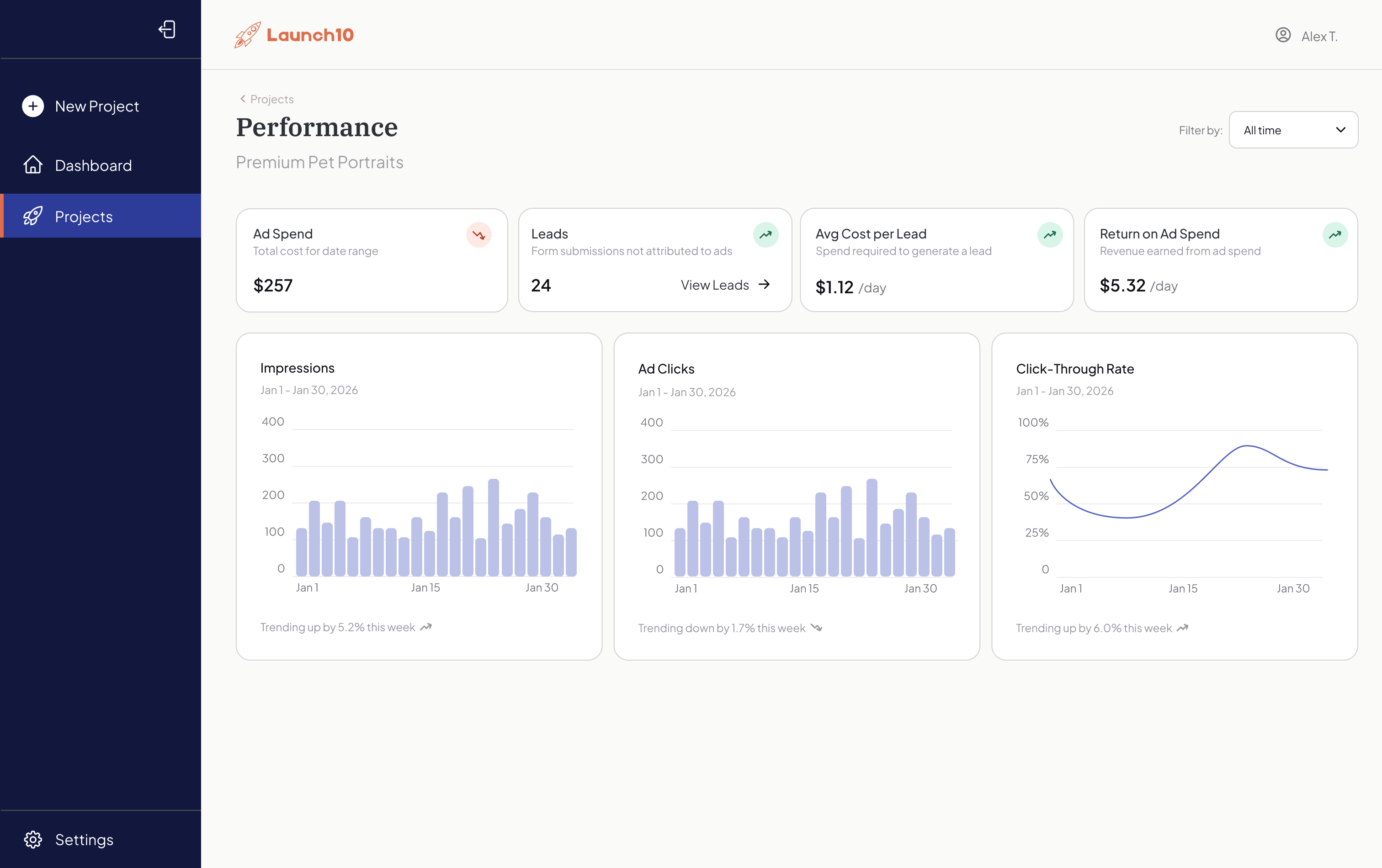
End-to-end tracking improves marketing ROI. This is not a one-time improvement — it compounds over time as connected systems learn which ads, keywords, and audiences produce the best customers.
Building a Connected Campaign: Three Approaches
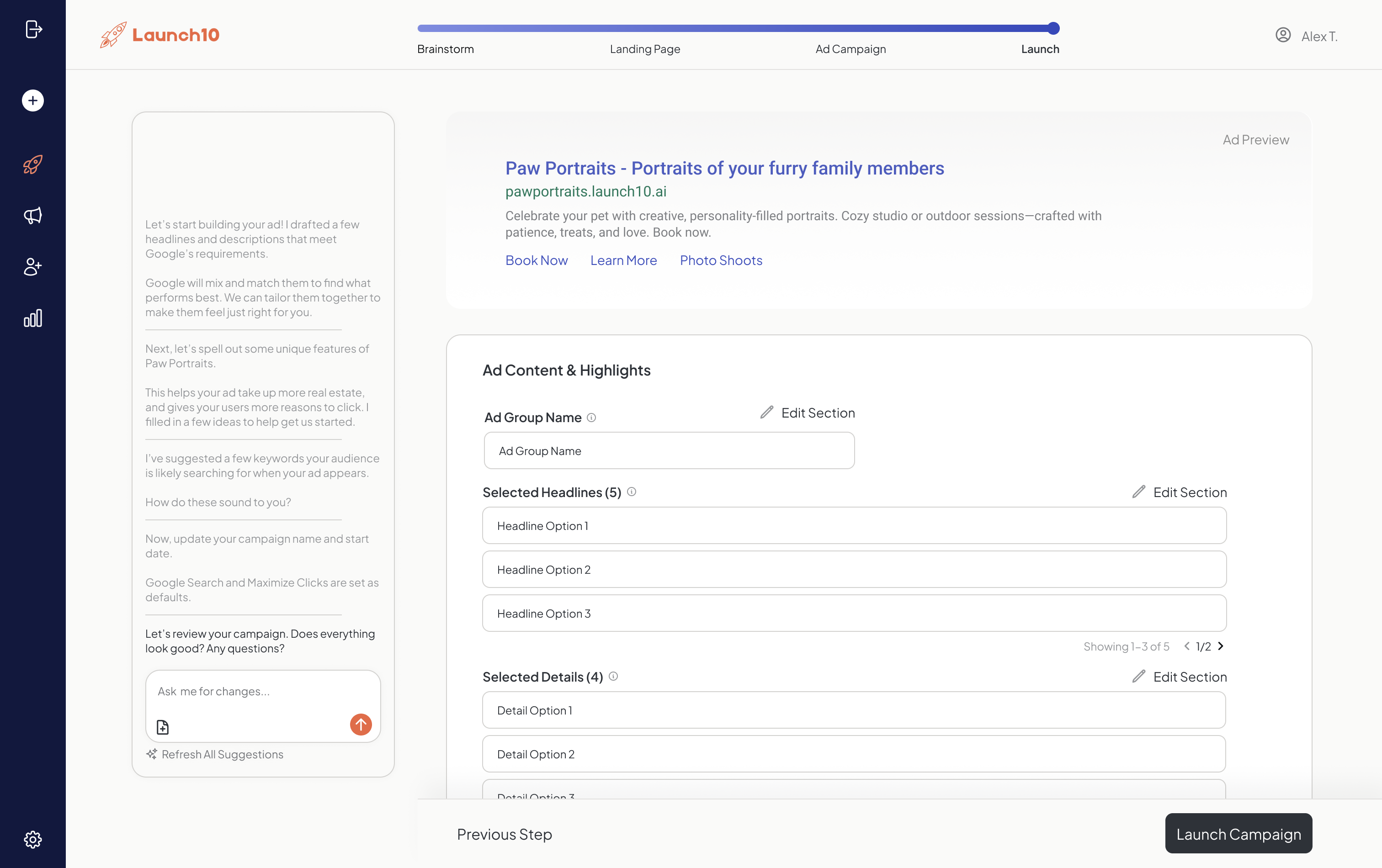
You can connect your campaign three ways: DIY with separate tools ($100-300/month, 15-40 hours setup), hire an agency ($1,000-5,000/month), or use an integrated platform like Launch10 ($59/month, 10 minutes). The right choice depends on your technical ability, your time, and your budget.
Approach 1: DIY with Separate Tools
You can build a connected campaign using separate tools — a landing page builder (Unbounce, Leadpages, or a custom site), Google Ads, Google Tag Manager, and Google Analytics. This works, but it requires significant technical skill and ongoing maintenance. The setup takes 10-20 hours if you know what you are doing, and maintaining message match and tracking integrity requires weekly attention. This approach makes sense if you have a marketing team or you personally enjoy the technical side of digital marketing. For most people, the complexity is the reason their campaign ends up disconnected in the first place.
Approach 2: All-in-One Platform
All-in-one platforms build the landing page, ad campaign, and tracking as a single connected system. Because everything is generated together, message match is automatic, tracking is built in, and the data loop works from day one without manual configuration. Launch10, for example, generates your landing page and Google Ads campaign from the same business description — the ad copy and page copy are aligned by design, not by manual effort. This approach trades granular control for speed, simplicity, and reliability. Plans start at $59/month, plus your ad spend goes directly to Google.
Approach 3: Hire an Agency
A good agency will build and maintain a connected campaign for you. They handle landing page creation, campaign management, tracking setup, and ongoing optimization. The downside is cost ($1,000-$5,000/month in management fees on top of ad spend) and dependency — if you leave the agency, you want to make sure you own your landing pages, your Google Ads account, and your data. Ask these questions before hiring: “Do I own my Google Ads account?” and “What happens to my landing pages if we part ways?” If the answers are not clear, keep looking.
How to Audit Your Current Campaign in 15 Minutes
You do not need to hire anyone to check whether your campaign is connected. Here is a quick audit you can run right now.
Message match check (5 minutes): Open your Google Ads account and look at your ad copy for each ad group. Then click through to the landing page each ad points to. Does the page headline match the ad headline? Does the page mention the same offer, the same location, the same service? If the ad says “Emergency AC Repair in Phoenix” and the page says “Welcome to Our Company,” you have a message match problem.
Conversion tracking check (5 minutes): In Google Ads, go to Tools > Conversions. Do you see conversion actions listed? Do they show recent conversions? If the “Conversions” column in your campaign reports shows zero or ”—” across all campaigns, your tracking is broken or missing. This means every dollar you spend is untracked.
Landing page check (5 minutes): For each ad group, verify that the landing page URL is a dedicated page (not your homepage). Check that the page loads in under 3 seconds on mobile. Verify that the page has one clear call to action — not five menu items and a sidebar full of links. Every navigation option on a landing page is a chance for the visitor to wander away from converting.
If all three checks pass, your campaign is in good shape. If one or more fail, the fix is straightforward — and the ROI improvement from fixing it will likely be immediate and significant. For home services businesses, these fixes are especially impactful because of the high CPC in the industry ($6.55 average).
The Bottom Line: Connection Is the Multiplier
Your landing page and your ads are not separate marketing activities. They are parts of one system, and that system performs dramatically better when the parts are connected. Message match doubles conversion rates. Proper tracking enables optimization that doubles again. The data feedback loop compounds those improvements over time.
Whether you connect the pieces yourself with separate tools, use an all-in-one platform, or hire an agency to manage it — the connection is what matters. Every dollar of ad spend flows through the campaign. The tighter and more connected that campaign is, the more of those dollars turn into customers. If you are spending money on Google Ads without a connected campaign, fixing that connection is the highest-ROI investment you can make in your marketing. Read our complete Google Ads guide for the full picture on campaign setup, budgeting, and optimization.
Related reading
- Why your Google Ads aren’t generating leads — diagnostic for campaigns where the connection failed
- Google Ads conversion tracking setup — wiring up the tracking that proves the connection works
- Google Ads guide for small business — full Google Ads primer
Frequently asked questions
What is message match in advertising?
Why shouldn't I send Google Ads traffic to my homepage?
How does landing page quality affect Google Ads cost?
What is an all-in-one marketing campaign platform?
How many landing pages should a business have?

Co-Founder & CEO, Launch10
Greg Hockenbrocht is the Co-Founder and CEO of Launch10. Before Launch10, he was on the executive leadership team at Fundera through its acquisition by NerdWallet, where he led Growth & New Ventures following the company's IPO. Through Illuminated Ventures and work with founders and business owners, he saw a need for Launch10 to help bring clarity, confidence, and ease to digital marketing.