
Launch10 for Founders: Validate Your Idea Before You Build

Launch10 lets founders validate business ideas in days, not months. Describe your idea, get a landing page and Google Ads campaign, and see real demand data from hundreds of searchers — for $59/month plus $300-$500 in ad spend. No code required, no agency needed.
The Most Expensive Mistake Founders Make
The most expensive mistake founders make is building a product before validating demand — a failed MVP typically costs tens of thousands of dollars.
The number one reason startups fail is building something nobody wants. Not running out of money, not bad timing, not getting outcompeted — building something nobody wants. CB Insights’ analysis of 101 startup post-mortems found that 42% cited “no market need” as the primary reason they shut down. That’s nearly half of all startup failures caused by a problem that could have been detected before writing a single line of code. The fix isn’t better engineering or more funding. It’s validation — putting your idea in front of real potential customers and measuring whether they care.
Yet most founders do the opposite. They spend 3 to 6 months building a minimum viable product, invest tens of thousands of dollars in development costs, and then launch to find out nobody wants it. The lean startup methodology — build, measure, learn — is supposed to prevent this. But “build” has become the default first step when it should be the last. You can test your idea before you build anything, and in 2026, it’s faster and cheaper than ever to do it.
“42% of startups fail because there’s no market need. That’s the #1 cause of failure — ahead of running out of cash, team problems, and competition combined.” — CB Insights, analysis of 101 startup post-mortems
The Landing Page Test: A Proven Validation Method
The landing page test is exactly what it sounds like: create a landing page describing your product, drive traffic to it with paid ads, and measure how many people take action. It’s not new. Dropbox famously used a demo video on a landing page to validate demand before the product existed — their waitlist went from 5,000 to 75,000 overnight. Buffer tested their pricing page before building the product and got paying customers on day one. These are now textbook examples taught in every startup accelerator.
The concept is simple but the execution has historically been painful. To run a landing page test, a founder traditionally needed to learn a page builder (Unbounce, Leadpages, Carrd), set up a Google Ads account, research keywords, write ad copy, configure conversion tracking, and then analyze the data. That’s 20 to 40 hours of work across 4 to 5 different tools — a massive time investment just to answer the question “does anyone want this?” Most founders either skip validation entirely or settle for weak signals like asking friends or posting on Reddit.
Launch10 compresses that entire process into 10 minutes. Describe your idea, and the platform generates a professional landing page, a Google Ads campaign targeting your potential customers, and conversion tracking — all connected. You go from “I have an idea” to “I’m collecting real market data” the same day. Read how Launch10 works for the full step-by-step process.
How Founders Use Launch10: A SaaS Validation Example
Let’s walk through a real scenario. Say you’re a founder with an idea for a project management tool built specifically for construction companies. You think there’s a gap in the market — existing tools like Asana and Monday.com aren’t designed for job sites, subcontractor coordination, and change orders. Before you spend $30,000 and four months building an MVP, here’s how you’d validate with Launch10.
Step 1: Describe Your Idea (3 Minutes)
You tell Launch10: “I’m building project management software for construction companies. It handles job scheduling, subcontractor coordination, change order tracking, and budget management. Built for general contractors and construction managers who find generic tools like Asana too complicated for field work.” That’s it. No wireframes, no mockups, no pitch deck. Just a clear description of what you’re building and who it’s for.
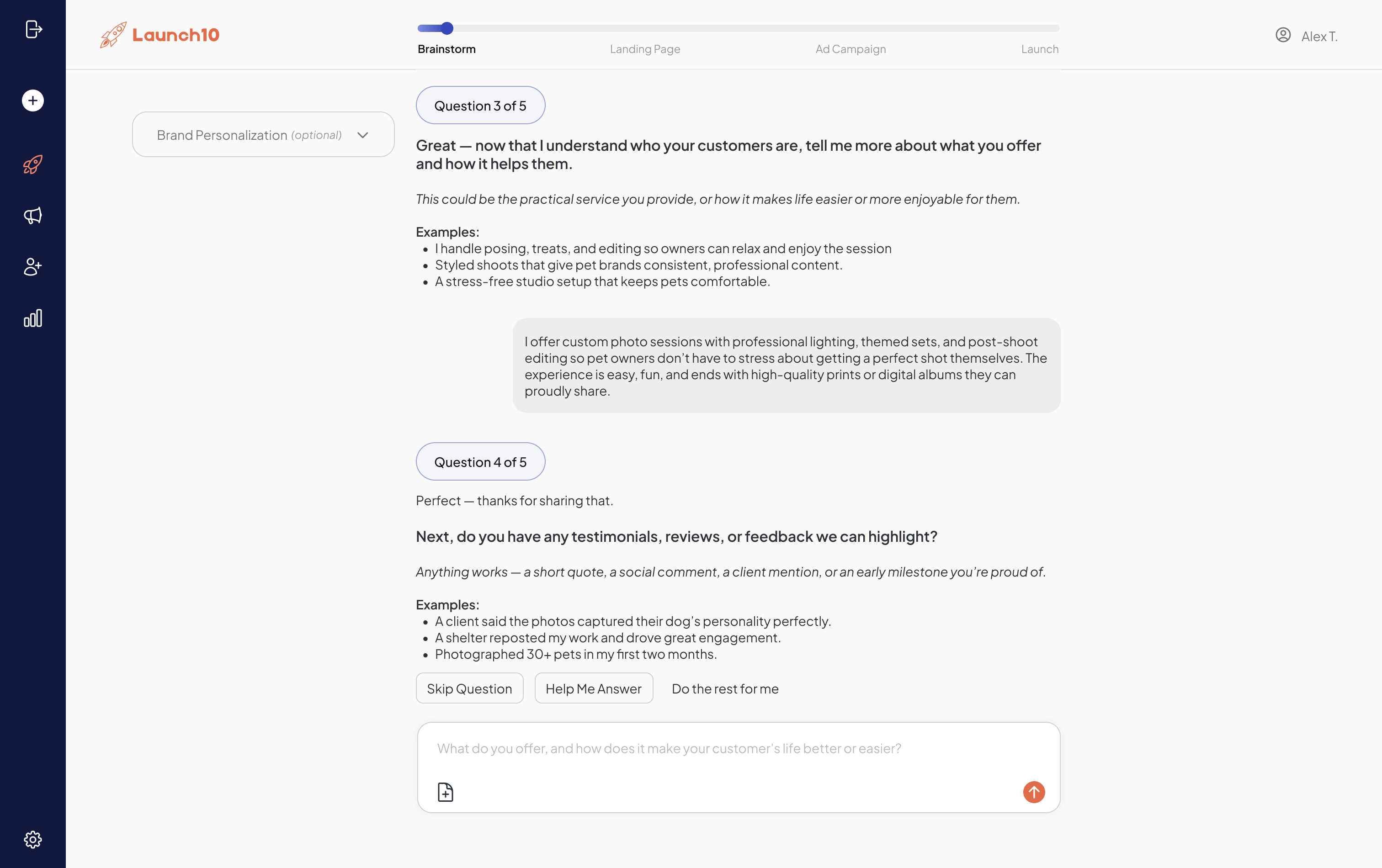
Step 2: AI Builds Your Validation Campaign (60 Seconds)
Launch10 generates a landing page that reads like a real product page — headline, value proposition, feature descriptions, and a call-to-action (“Request Early Access” or “Join the Waitlist”). It also creates a Google Ads campaign targeting searches like “construction project management software,” “contractor scheduling tool,” and “construction job management app.” Conversion tracking is configured automatically so every signup gets attributed to the specific search term that drove it.
Step 3: Set Your Budget and Go Live
You connect your Google Ads account (Launch10 walks you through creating one if you don’t have it), set a daily budget — $20 to $30 per day is plenty for validation — and launch. Your ads start appearing to people actively searching for construction project management tools. These aren’t friends doing you a favor or survey respondents giving polite answers. These are real people with real problems spending real time searching for a solution. That distinction is everything.
What the Data Tells You: Reading Your Validation Results
A conversion rate above 5% signals strong demand, 2-5% is promising and worth iterating on, and below 1% means you should pivot.
After one to two weeks of running ads with $300 to $500 in spend, you’ll have statistically meaningful data. Here’s how to interpret what you see, based on benchmarks from thousands of Google Ads landing page tests across SaaS, marketplaces, and digital products.
Conversion Rate Benchmarks for Idea Validation
| Landing Page Conversion Rate | Signal Strength | What It Means |
|---|---|---|
| Above 5% | Strong demand signal | People actively want this. Build it. |
| 2% to 5% | Promising, needs refinement | Interest exists but positioning may need work. Test new messaging. |
| 1% to 2% | Weak signal | Some interest, but not compelling enough. Rethink the value prop or audience. |
| Below 1% | No meaningful demand | Either the market doesn’t want this, or you’re reaching the wrong people. Pivot or reframe. |
These benchmarks assume your landing page is well-written and your ads are targeting relevant keywords — both of which Launch10 handles automatically. A 5% conversion rate on a landing page test is a strong green light. It means 1 in 20 people who searched for a solution and clicked your ad cared enough to give you their email or request access. In the Google Ads ecosystem, where average landing page conversion rates hover around 4.4% across all industries (WordStream, 2025), anything above 5% for a product that doesn’t exist yet is a powerful signal.
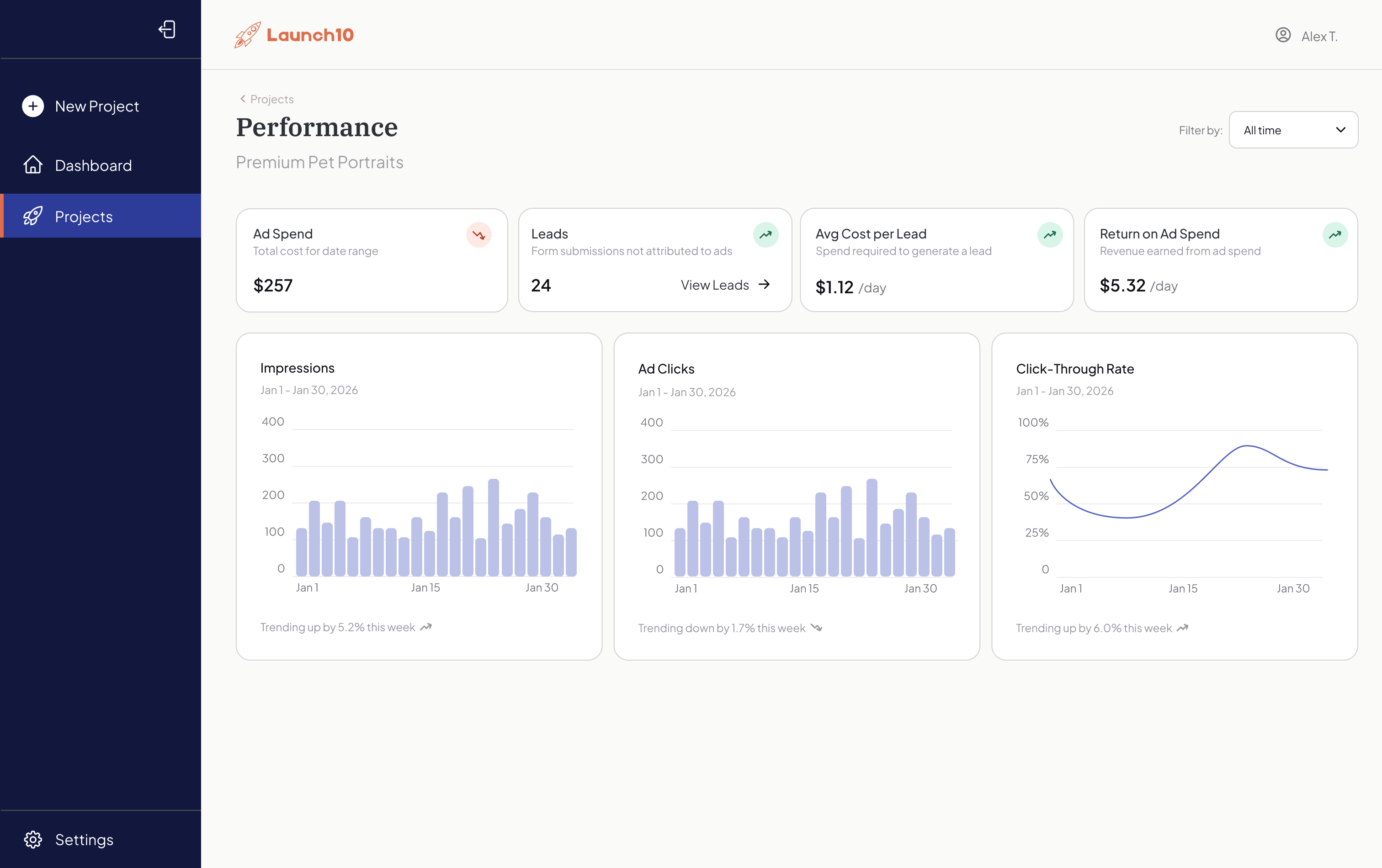
But raw conversion rate isn’t the only thing to look at. Launch10’s tracking shows you which search terms drove signups. If people searching “construction project management software” convert at 7% but “contractor scheduling app” converts at 0.5%, you’ve learned something critical about how your market thinks about the problem. That data shapes not just whether to build, but what to build and how to position it.
The Cost of Validation vs the Cost of Building Wrong
This is the math that should change every founder’s approach to starting a company. The cost of validating an idea with Launch10 and Google Ads is a fraction of the cost of building an MVP — and the information you get is significantly more reliable than any other validation method short of actually selling the product.
| Landing Page Test (Launch10) | MVP Build | Survey / Interviews | |
|---|---|---|---|
| Cost | $59/mo + $300–$1,000 ads | $15,000–$50,000 | $0–$500 |
| Time to Data | 1–2 weeks | 3–6 months | 2–4 weeks |
| Data Quality | Real behavior from real searchers | Real usage data | Stated preferences (unreliable) |
| What You Learn | Demand exists, positioning works, keywords convert | Product-market fit | What people say they’d do (not what they’d actually do) |
| Risk if Wrong | $360–$1,060 lost | $15,000–$50,000 + months lost | False confidence |
“$500 in Google Ads spend can tell you in two weeks what a $30,000 MVP would take three months to reveal — whether real people actually want what you’re planning to build.”
Y Combinator’s core advice to founders is “talk to users” and “do things that don’t scale.” A landing page test is the scaled version of talking to users — except instead of 20 interviews where people tell you what you want to hear, you get data from 500 real searchers showing you what they actually do. The roughly 50% five-year startup failure rate — per Bureau of Labor Statistics data — isn’t because founders can’t build products. It’s because they build products without evidence of demand. A $500 test can prevent a $50,000 mistake.
The Iteration Loop: Test, Learn, Adjust, Retest
Run three rounds of testing over 6-9 weeks: validate the core offer, then test messaging variations, then refine your audience targeting.
Validation isn’t a one-shot experiment. It’s a loop. The most successful founders don’t run one test and make a binary build-or-don’t-build decision. They run multiple rounds, each one refining the idea based on real data. Launch10 makes this loop fast because creating a new campaign takes 10 minutes, not 10 days.
Round 1: Test the Core Idea
Run your initial landing page and ads for one to two weeks. Collect data on conversion rate, cost per signup, and which search terms convert. At this point you’re answering the most basic question: does anyone care? If your conversion rate is below 1% after 200+ clicks, the idea in its current form isn’t resonating. But that doesn’t necessarily mean the idea is dead — it might mean the positioning is wrong.
Round 2: Test the Positioning
Take what you learned from Round 1 and create a new campaign with different messaging. Maybe your construction PM tool got low conversions when positioned as “project management” but the search term data showed interest in “construction scheduling.” Build a new landing page focused on scheduling instead of general project management. This takes 10 minutes with Launch10 — you don’t need to redesign anything from scratch. With the Starter plan, you get 2 campaigns per month, enough for iterative testing. The Growth plan gives you 10.
Round 3: Test Pricing and Willingness to Pay
Once you’ve found messaging that converts above 3 to 5%, add a pricing page to your landing page. Launch10 can generate pages with pricing tiers. Now you’re not just measuring “do people want this” — you’re measuring “will people pay for this, and how much?” This is the Buffer method: Joel Gascoigne put up a pricing page before Buffer existed and collected email addresses from people who clicked a pricing tier. The conversion data told him not just that demand existed, but what people were willing to pay.
When to Build vs When to Pivot
After two to three rounds of testing, you’ll have enough data to make a confident decision. Build if your conversion rate is consistently above 3 to 5%, you’ve validated messaging that resonates, and you have a growing waitlist of people who’ve expressed real intent. Pivot if you can’t get above 2% conversion after multiple positioning attempts, or if the keywords that convert don’t align with the business you want to build. Kill the idea if nothing converts after testing three or more distinct value propositions — the market is telling you something, and the smartest move is to listen.
Beyond Validation: Launch10 Grows With You
Once validated, your Launch10 campaign becomes your production marketing system — the same landing page and campaign that proved demand can scale to acquire customers.
Here’s what most validation tools miss: if your test succeeds, you need to keep marketing. The same Launch10 campaign you used for validation becomes your customer acquisition engine. You don’t need to rebuild anything on a different platform. Your landing page, your ads, your tracking — it all stays live and keeps working while you build the product.
Many founders on Launch10 run their validation campaign, start building the product, and use the waitlist signups as their beta user pool. The landing page evolves from “Request Early Access” to “Start Your Free Trial” as the product materializes. Your Google Ads campaign keeps running, now driving users to your actual product instead of a waitlist. The cost stays the same — $59/month on the Starter plan — and you’ve had continuous market data from day one.
For context on how Launch10 compares to standalone page builders for this use case, read our comparisons against Unbounce and Leadpages. The core difference: those tools build pages. Launch10 builds the entire validation system — page, ads, tracking, and data — in one step.
What Launch10 Won’t Tell You
Intellectual honesty matters, so here’s what a landing page test cannot validate. It won’t tell you if you can build the product. Technical feasibility is a separate question. It won’t tell you if the unit economics work at scale. You might validate demand for a product that costs more to deliver than customers will pay. It won’t tell you about retention — people who sign up for a waitlist may not stick around once the product ships. And it won’t tell you about the competitive landscape in detail — your conversion rate reflects current market conditions, which can change.
What it will tell you, definitively, is whether real people are actively searching for a solution to the problem you want to solve, and whether your description of that solution compels them to take action. That single data point eliminates the #1 cause of startup failure. For $59 plus a few hundred dollars in ad spend, that’s the best insurance policy a founder can buy. Learn more about the platform in our complete overview of Launch10.
Related reading
- What is Launch10? — product overview and category positioning
- Launch10 pricing guide — plan breakdowns
- Connecting your landing page and ads — foundational message-match concept
Frequently asked questions
How much ad spend do I need to validate an idea?
Can I validate a B2B idea with Google Ads?
What if nobody searches for my idea?
How long should I run my validation test?
What's the difference between this and just putting up a Carrd page?
Can I run multiple idea tests at the same time?

Co-Founder & CEO, Launch10
Greg Hockenbrocht is the Co-Founder and CEO of Launch10. Before Launch10, he was on the executive leadership team at Fundera through its acquisition by NerdWallet, where he led Growth & New Ventures following the company's IPO. Through Illuminated Ventures and work with founders and business owners, he saw a need for Launch10 to help bring clarity, confidence, and ease to digital marketing.