
Google Ads for Electricians: Book More Jobs

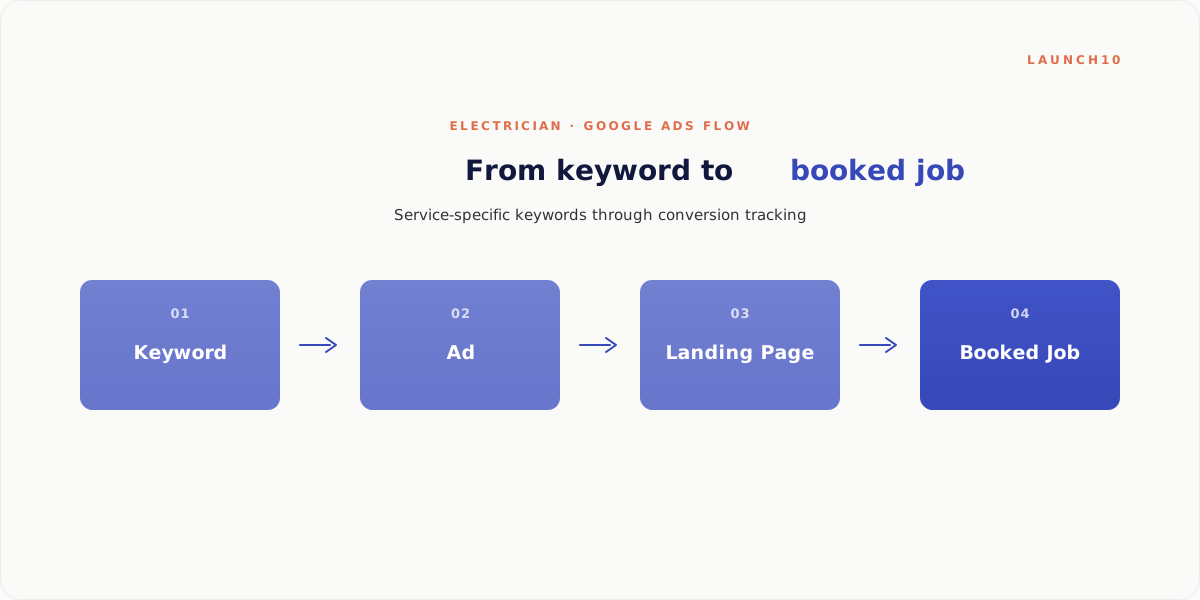
Google Ads is one of the fastest ways for an electrical contractor to fill the schedule — but it’s also one of the easiest to waste money on. Clicks in competitive trades markets can run well above the broader home-services average (WordStream pegs Home & Home Improvement at $7.85 average CPC in 2025, with meaningful variance by service and geography), which means a poorly structured campaign can burn through a month’s budget in days without producing a single booked job. The electricians who run profitable Google Ads don’t spend more than their competitors. They structure campaigns around service-specific keywords, send traffic to landing pages that match the ad, and track cost per booked job instead of cost per click.
This guide covers the specific Google Ads setup that works for residential electrical contractors: which keywords convert, what the landing pages need, how to set up tracking that reveals which campaigns actually produce booked work, and the mistakes that make electrical PPC more expensive than it needs to be — all built on how Google Ads works for small businesses, narrowed to electrical services.
Why Google Ads Works Differently for Electricians
Electrical work sits at the high-trust, often high-urgency end of the home-services spectrum, which changes every decision about keyword selection, ad copy, and landing page design.
Three factors shape electrical PPC. First, intent varies widely by service. A search for “emergency electrician [city]” represents a homeowner in distress — high intent, high close rate, high willingness to pay premium rates. A search for “EV charger installation cost” represents a homeowner in the research phase — lower immediate conversion, but potentially higher ticket if they choose you. Campaigns that mix these intents in a single ad group perform worse than campaigns that treat them as separate services.
Second, licensing and insurance signals do heavy lifting. Electrical customers over-index on credentials compared to other home services, because the failure modes (electrical fires, code violations, resale problems) are serious. Ad copy that surfaces “Licensed Master Electrician” or “Fully Licensed and Insured in [State]” converts better than ad copy that only emphasizes price or speed.
Third, the landing page is a disproportionately large lever. Homeowners who click an ad for “panel upgrade [city]” and land on a generic electrical contractor homepage leave at much higher rates than visitors who land on a panel-upgrade-specific page. Dedicated landing pages consistently outperform generic homepages on paid traffic across every tracked industry benchmark. Every landing page should match its ad; every ad should match the service keyword; every keyword should target a specific intent.
The Right Keywords for Electrician Google Ads
Keyword selection determines whether your budget reaches homeowners ready to book or gets wasted on low-intent searches and wrong-industry clicks.
Start with service-specific keywords combined with location modifiers. The highest-converting electrical keywords combine a specific service with a city or neighborhood:
- “Panel upgrade [city]”
- “EV charger installation [city]”
- “Emergency electrician [city]”
- “Electrical inspection [city]”
- “Generator installation [city]”
- “Whole house surge protector [city]”
- “Ceiling fan installation [city]”
Each of these targets a homeowner with a specific problem, at a specific intent level, in a specific market. That specificity is what drives both Quality Score (Google rewards keyword-to-ad-to-landing-page match) and close rate.
Avoid generic category keywords unless you have budget to burn. “Electrician,” “electrical contractor,” and “electrician near me” all get clicked by homeowners in early research phases, renters looking for information about their landlord’s responsibilities, and students exploring the trade. The clicks cost the same as service-specific keywords but convert at a fraction of the rate.
Build a strong negative keyword list. This is where most electricians leave money on the table. Without negative keywords, your ads show up for searches like “electrician school,” “how to become an electrician,” “electrician salary,” or “DIY electrical wiring.” Add negatives for:
- Career and training searches (“school,” “apprenticeship,” “salary,” “how to become”)
- DIY searches (“DIY,” “how to,” “myself,” “tutorial”)
- Unrelated services your team doesn’t handle (if you’re residential-only, exclude “commercial,” “industrial,” “data center”)
- Geographic areas outside your service zone
Match types matter. Broad match keywords in electrical PPC waste budget fast. Phrase match and exact match give you control over which searches trigger ads. Review your search terms report weekly for the first 60 days of a new campaign — you’ll find irrelevant queries to add as negatives that wouldn’t show up any other way.
Landing Pages That Match Electrician Ads
Sending Google Ads traffic to a general electrical contractor homepage is the single most expensive mistake in electrician PPC. Service-specific landing pages routinely double conversion rates from the same ad spend.
A landing page that converts residential electrical traffic shares a predictable structure:
- Service-matched headline. If the ad said “EV Charger Installation in [City] — Licensed Electricians,” the headline says exactly that. Every word of friction between “this is what I searched” and “this is what the page offers” is ad spend lost.
- Licensing and insurance visible near the fold. “Master Electrician, licensed and insured in [State], License #X.” Specific credentials with specific numbers. Vague “fully insured” claims convert worse than specific ones.
- Phone number visible everywhere. Sticky header on mobile, large tap-to-call button, repeated mid-page and at bottom. Electrical customers call more than they fill forms.
- Trust stack. Google Verified badge if you’re LSA-enabled, BBB rating, years in business, recent review with reviewer’s actual first name and photo.
- Real service photos. Actual panel upgrades you’ve installed, not stock photography. A panel photo with a service label tells the customer you’ve done this exact job before.
- Pricing range where you can. “EV chargers typically $1,200–$2,500 installed, depending on panel capacity and charger type.” Specific ranges convert better than “Call for a quote” because they handle the price objection up front.
- One primary call to action. Call or schedule online. Don’t split attention across three CTAs.
- Stripped navigation. Landing pages aren’t homepages. No About page link, no blog sidebar, no social media icons that invite exits.
Dedicated landing pages consistently outperform generic site pages on paid traffic. Unbounce’s 2025 Conversion Benchmark Report puts the median landing-page conversion rate across industries around 6.6%. Electricians who rebuild paid-traffic landing pages around the principles above consistently see meaningful booking-rate lift from the same ad budget — almost always the largest single ROI improvement available in the marketing system.
If your ads are running but bookings aren’t materializing, the landing page is almost always the bottleneck. We covered this pattern in why connecting your ads and landing pages matters.
Conversion Tracking for Electrical Leads
Most electricians running Google Ads can tell you their cost per click. Far fewer can tell you cost per booked job by keyword. That gap is where budget efficiency lives.
The tracking stack isn’t complicated but it takes intention to set up:
- Call tracking numbers on every landing page. Different numbers per campaign and service so you know which ad produced each call.
- Conversion events firing for qualified calls and form submissions. Use call-tracking platforms (CallRail, etc.) with custom qualification workflows — outcome tagging paired with duration signals rather than a blanket duration threshold. Send these conversions back to Google Ads so the algorithm can optimize toward real outcomes, not just clicks.
- Job-source field in your dispatch or CRM system. Every booked job tagged with where it originated so monthly marketing reconciliation becomes possible.
- Assign values to conversions. A panel upgrade is worth more than a ceiling fan install. Telling Google Ads the relative value of each conversion type lets the algorithm optimize toward the most valuable jobs, not just the most leads.
Electricians who install this stack consistently find that one or two keywords in their campaigns are producing most of their booked jobs, and the rest are inflating cost averages. Pausing the low-performers and reallocating budget to winners typically produces meaningful improvements in cost per booked job without any change in total ad spend.
For the specific mechanics of setting up conversion tracking, our Google Ads conversion tracking setup guide walks through each step. For the broader context of why campaigns underperform, why Google Ads aren’t generating leads covers the most common failure modes.
Our companion piece on electrician marketing more broadly covers the channel mix beyond Google Ads — GBP, LSAs, referrals — that pairs with paid search to build a complete pipeline.
Common Electrician Google Ads Mistakes
The decisions that routinely waste electrical PPC budgets:
- Running Google Ads before maxing Local Services Ads. LSAs cost less per lead and include the Google Verified badge. Max LSAs first.
- Targeting “electrician” as a primary keyword. Too broad, too expensive, too low-intent. Service + location keywords convert far better.
- Sending traffic to the homepage. Wastes a substantial portion of ad spend versus dedicated landing pages (Unbounce median LP CVR across industries is 6.6%).
- No negative keywords. Within weeks, budget gets consumed by clicks from students, renters, and unrelated searches.
- No call tracking. Reallocation decisions become guesses.
- Ignoring the search terms report. The single most valuable 10 minutes of weekly maintenance for a new campaign.
- Broad match keywords at launch. Flexible, but flexibility has a cost until the campaign is proven.
How Launch10 Supports Electrician Google Ads
Launch10 is purpose-built AI for residential electricians who want to run Google Ads directly rather than hand campaigns to an agency and hope. The platform generates service-specific landing pages that match your ad copy, sets up conversion tracking from day one, and monitors campaign performance against cost per booked job — the metric that determines whether ads are actually growing the business.
For an electrical contractor running $2K–$12K/month in Google Ads, the typical outcome is more booked jobs per ad dollar and transparent visibility into which campaigns produce work versus which are burning budget.
Related reading
- Electrician marketing playbook — broader marketing for residential and commercial work
- Google Ads for HVAC — adjacent home-services vertical
- Why your Google Ads aren’t generating leads — foundational diagnostic
Frequently asked questions
How much should electricians spend on Google Ads?
Should electricians run Google Ads or Local Services Ads first?
What's a good cost per click for electrician Google Ads?
What keywords work best for electrician Google Ads?

Co-Founder & CEO, Launch10
Greg Hockenbrocht is the Co-Founder and CEO of Launch10. Before Launch10, he was on the executive leadership team at Fundera through its acquisition by NerdWallet, where he led Growth & New Ventures following the company's IPO. Through Illuminated Ventures and work with founders and business owners, he saw a need for Launch10 to help bring clarity, confidence, and ease to digital marketing.