
Electrician Marketing: Building a Pipeline of Residential and Commercial Work

Electrician marketing has a split-personality problem most trades don’t face. Residential electrical work — panel upgrades, EV charger installations, emergency power restoration, lighting remodels — follows the home-services playbook: Google Business Profile, Local Services Ads, Google Ads with landing pages, systematic reviews. Commercial electrical work — new construction, tenant improvements, retrofit contracting — runs on an entirely different system: relationships with general contractors, commercial bidding, trade association membership, and outbound outreach to property managers. Most electricians try to market both with a single strategy and underperform in both.
This guide treats them as the two separate businesses they are: how residential electricians build a consistent lead pipeline through local search, and how commercial electricians build relationships with the GCs and property managers who control most commercial electrical spend.
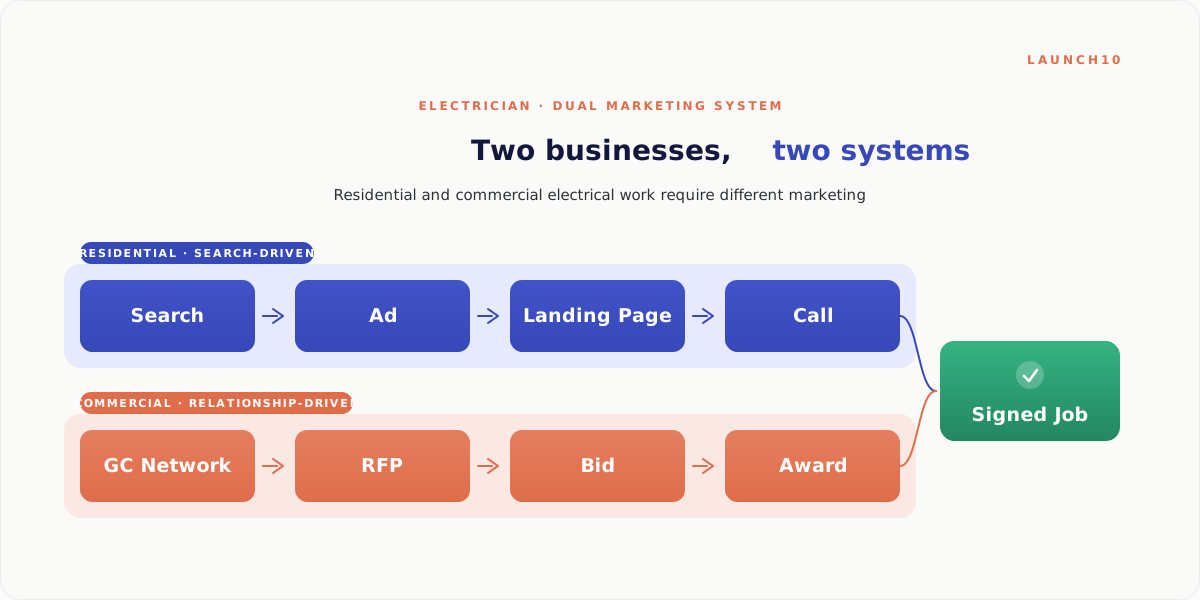
The Residential vs. Commercial Split Changes Everything
A residential electrician and a commercial electrician are in fundamentally different businesses. The marketing strategies that work for one are expensive distractions for the other.
Three dynamics drive the split. First, the buyer is different. Residential customers are homeowners searching online for a specific problem — a tripping breaker, an EV charger install, a panel upgrade for a solar install. Commercial customers are general contractors, property managers, and facilities directors who procure work through bid processes, existing relationships, and trade networks.
Second, the decision timeline is different. A homeowner decides within a day, usually within an hour. A GC typically plans commercial electrical work weeks or months in advance as part of a larger project schedule. Marketing that works for a one-day decision cycle (emergency ad copy, fast intake response) is the wrong tool for a three-month procurement cycle.
Third, the trust signals that matter are different. Residential customers care about reviews, licensing, insurance, and visible trust cues. Commercial customers care about demonstrated experience on similar projects, prompt RFP responses, clean safety records, and whether your crew has worked with this GC’s other subs successfully.
Electricians who run a significant mix of both revenue types should run two marketing systems in parallel, budget them separately, and measure them separately. Electricians with 90%+ residential can ignore commercial marketing entirely. Electricians with 90%+ commercial can ignore most of the residential playbook.
The Residential Playbook: Channels That Produce Qualified Leads
For residential-focused electricians, the bulk of qualified leads typically come from a handful of channels. In rough order of payoff:
- Google Local Services Ads (LSAs). Pay-per-lead, top-of-results placement, and the Google Verified badge signals trust to homeowners making fast decisions. For most residential electricians, LSAs should be maxed before any other paid channel scales.
- Google Business Profile (GBP). A fully optimized GBP with weekly posts, real job photos (especially panel upgrades and EV chargers, which are visually distinctive), 80+ reviews, and owner responses captures the majority of “electrician near me” and “electrician [city]” searches.
- Google Ads on service-specific keywords. “Panel upgrade [city],” “EV charger installation [city],” “emergency electrician [city].” Service-specific keywords outperform generic “electrician” terms every time on cost, conversion, and Quality Score — how to run Google Ads on a small budget walks through the setup.
- Review generation. Automated review workflows materially increase review volume; Birdeye reports that Complete Care grew reviews per location by 3,653% after automating review requests. BrightLocal’s 2026 Local Consumer Review Survey finds 97% of consumers read reviews for local businesses.
Channels that underperform for residential electricians specifically: Facebook and Instagram ads (intent is too low for emergency electrical work, though EV charger installs occasionally convert). Direct mail (works for planned upgrades but not for reactive needs). Lead aggregators like HomeAdvisor and Angi (same shared-lead dynamics as other home services; shared leads tend to close at low rates).
The Commercial Playbook: Relationships, Not Search
Commercial electrical work is sold through relationships. The marketing activities that build those relationships don’t look like marketing.
For commercial-focused electricians, the channels that produce work:
- General contractor relationships. The most important asset for a commercial electrician is a short list of GCs who call you first when they need an electrical sub. Building this list is years of work: bidding competitively, finishing clean, showing up when promised, and handling change orders without drama. Marketing for commercial electricians is mostly relationship management.
- Property manager and facilities director outreach. For service and retrofit work (not new construction), property managers of commercial buildings and facilities directors of larger organizations control ongoing electrical spend. A quarterly check-in email and an occasional in-person meeting usually outperforms any advertising.
- Trade association participation. Chamber of commerce membership, IEC (Independent Electrical Contractors) local chapter, and NECA (National Electrical Contractors Association) involvement produce referrals that don’t come through search.
- A credible commercial portfolio on the website. Not for inbound leads — for the RFP process. When a GC is evaluating a new electrical sub, they’ll look at the website and expect to see commercial project photos, licensing, insurance certificates, and safety program documentation. The website isn’t generating leads; it’s qualifying you after someone else referred you.
- Targeted LinkedIn presence. Less for direct outreach and more for being findable when a facilities director searches for an electrician after a colleague’s recommendation.
Licensing, Insurance, and Trust Signals Unique to Electrical
Electrical work has higher perceived stakes than most trades because the failure modes are severe: fire, electrocution, code violations that show up at resale. Trust signals carry more weight here than they do in plumbing or HVAC.
Specific trust elements every electrician should surface prominently in marketing:
- Master Electrician credentials. Where applicable, this credential signals higher-level qualification and justifies premium pricing. Don’t bury it on an About page.
- Full licensing details with license numbers. Displayed on the website footer, trucks, and landing pages. Skeptical customers verify.
- Insurance certificates (general liability, workers comp). Not just “fully insured” — the specific coverage limits and named carrier. Commercial customers will ask for COIs anyway.
- Continuing education and code compliance. NEC compliance is a legal requirement, but signaling that the team stays current on code updates (especially for newer domains like EV charging, solar integration, battery backup) converts the customers who care about doing it right.
- Manufacturer certifications. Generator dealer certifications, Tesla charger installation certification, solar installer partnerships. These are specific trust markers that justify higher rates.
The Landing Page That Converts Residential Electrical Traffic
An electrical landing page converts when it answers one question in 30 seconds: “Can this electrician solve my specific problem, do it safely, and do it this week?”
Landing pages that produce calls share a predictable structure:
- Service-matched headline. If the ad said “EV charger installation — [City] licensed electrician,” the landing page says exactly that. Generic “Welcome to Ace Electric” kills conversion.
- Licensing and insurance above the fold. “Master Electrician, licensed and insured in [State]” with specific license numbers visible. Electrical customers over-index on this.
- Phone number everywhere. Top of page, sticky on mobile, repeated mid-page. Electrical customers call more than they fill forms — especially for emergencies.
- Trust stack near fold. Google Verified badge (if LSA-enabled), BBB rating, years in business, a recent review with reviewer name and photo.
- Service-specific photos. A panel upgrade landing page shows panel upgrade photos. An EV charger landing page shows EV charger installations. Not stock photos of generic electricians.
- Pricing signal where possible. “Panel upgrades typically $X–$Y depending on amperage” converts better than “Call for a quote” because it handles the price objection up front.
- Stripped navigation. Landing page, not homepage. No links to About, Blog, or other services that might distract from the booking decision.
Dedicated landing pages consistently outperform generic site pages on paid traffic. Unbounce’s 2025 Conversion Benchmark Report puts the median landing-page conversion rate across industries around 6.6%. Electricians that rebuild paid-traffic landing pages around the principles above consistently see meaningful call-volume lift from the same ad spend — which is typically the highest-ROI lever most operations have available.
The principle here is covered in more depth in our landing page and ads integration guide.
Tracking That Shows Which Marketing Produces Jobs
Most electricians measure their monthly ad spend. The ones who grow fastest measure cost per booked job by channel and reallocate accordingly.
The tracking stack:
- Unique phone numbers per channel. LSAs, Google Ads, GBP, commercial referrals — each with a distinct tracked number.
- Job-source field captured at intake. CRM or dispatch software should record source on every call.
- Residential vs. commercial tagging. So the two businesses can be evaluated separately.
- Monthly reconciliation. Spend by channel against booked-job revenue by source, reviewed the same day every month.
Electricians who install this stack consistently find one or two channels are doing more work than expected and one or two are underperforming. Reallocating based on data is where the real ROI improvements live.
For the specific setup mechanics, start with our Google Ads conversion tracking guide.
Common Electrician Marketing Mistakes
The decisions that routinely cost electricians the most:
- Running one marketing strategy for both residential and commercial work. They’re different businesses.
- Running Google Ads before maxing LSAs. Almost always overpays per residential lead.
- Ignoring GBP. Free, high-intent traffic going to competitors with better profiles.
- Homepage landing pages. Wastes a substantial portion of paid ad budget that service-matched landing pages would convert.
- Under-signaling licensing and insurance. Electrical is a trust-heavy category; burying credentials hurts conversion.
- No commercial relationship program. Commercial revenue that depends on Google Ads will underperform commercial revenue that depends on GC relationships every time.
- Discount pricing as the differentiator. Race-to-the-bottom attracts customers who don’t refer.
Launch10 — Built for Electricians Who Want Booked Jobs, Not a Website Project
We built Launch10 for the residential electrician — and the agencies serving them — whose actual job is wiring panels and installing EV chargers, not learning Google Ads. People asked us for dispatch and job-costing tools constantly; we said no. ServiceTitan and Housecall Pro already do that work. We built the opposite: a single connected system that handles the landing page and the Google Ads campaign and the conversion tracking and the attribution dashboard.
Here’s what that gets an electrical contractor running paid search:
- Real ad cost data baked in, not guessed. Live keyword cost and competition for your service area — no bidding blind on “electrician near me” or “EV charger installation [city].”
- Pages built to win Quality Score. Sub-second LCP, mobile-first, zero bloat — the boring stuff Google rewards with cheaper clicks.
- Service-specific landing pages and Google Ads generated together (panel upgrade, EV charger, emergency, lighting remodel), on every plan including Starter.
- Click-to-call tracking out of the box. Call tracking, GCLID, conversion events, and dollar attribution so you can answer “cost per booked job” by campaign.
- Leads delivered wherever you already work. ServiceTitan, Housecall Pro, Jobber, your dispatcher’s inbox — plus 5,000+ apps via Zapier.
This is not a field-service-management platform. We run the marketing layer that fills the dispatch board.
Best for: Residential electrical contractors running $2K–$12K/month in paid ads, plus the agencies and in-house marketers serving them.
Related reading
- Google Ads for electricians — the tactical campaign-build companion
- Why your Google Ads aren’t generating leads — diagnose campaigns before blaming the page
- Connecting landing pages to ads — what most contractor sites get wrong on the ad-to-page handoff
- Chiropractor marketing — the same local-service playbook applied to a healthcare practice
Frequently asked questions
What's the best marketing channel for electricians?
How do electricians get commercial work?
What's a good cost per lead for residential electricians?
Do electricians need a website for marketing?

Co-Founder & CEO, Launch10
Greg Hockenbrocht is the Co-Founder and CEO of Launch10. Before Launch10, he was on the executive leadership team at Fundera through its acquisition by NerdWallet, where he led Growth & New Ventures following the company's IPO. Through Illuminated Ventures and work with founders and business owners, he saw a need for Launch10 to help bring clarity, confidence, and ease to digital marketing.