Can AI Run Your Google Ads? Top LLMs Compared

You Asked ChatGPT to Run Your Google Ads. Here’s What Happened.
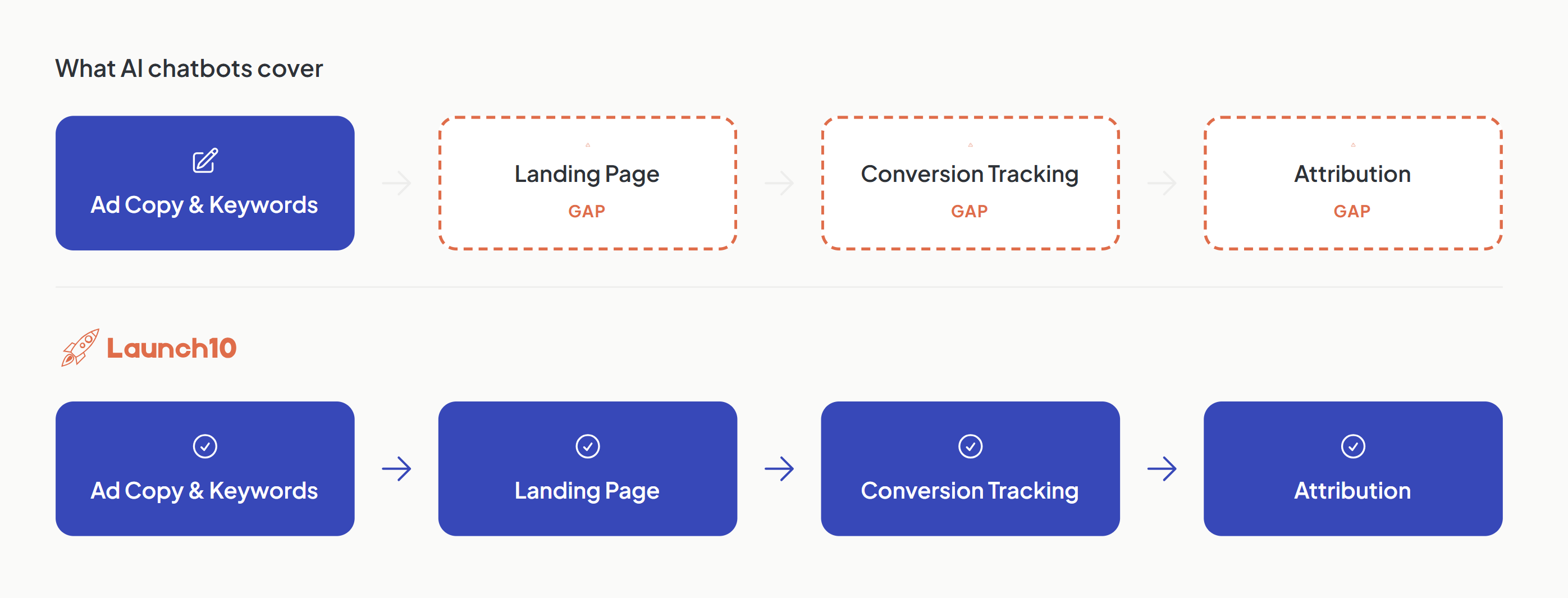
General-purpose AI like ChatGPT can write decent ad copy, but ad copy is only one piece of a working Google Ads campaign. A complete campaign requires a landing page, conversion tracking, keyword strategy, and attribution — none of which chatbots can build or configure.
You asked ChatGPT to create a Google Ads campaign. It gave you headlines, descriptions, and keywords. You launched it. Three weeks later, you’ve spent $800 and can’t tell if a single click turned into a customer.
This is the most common story we hear from people trying to use AI for Google Ads. The copy was fine. The keywords made sense. But somewhere between “here are your ad headlines” and “here are the customers who came from those ads,” everything fell apart.
ChatGPT, Claude, and Gemini are brilliant at generating text, but they cannot build or connect the systems that make that text produce customers. Purpose-built AI platforms like Launch10 use AI differently — not just for writing copy, but for building landing pages, configuring campaigns, setting up tracking, and optimizing based on real performance data. It is still AI. It is just AI designed to solve the whole problem, not just the writing part.
What AI Tools Actually Do Well
General-purpose AI tools excel at three things: writing ad copy, suggesting keyword ideas, and explaining Google Ads concepts. We have used all four of these tools extensively, and they are legitimately helpful for specific parts of the Google Ads workflow.
Ad copy generation. ChatGPT and Claude are excellent at writing responsive search ad headlines and descriptions. Give them your business, your audience, and your offer, and they will produce dozens of variations in minutes. Claude tends to be more concise. ChatGPT produces more volume. Both are better than what most people write on their own. In fact, Google reports that improving Responsive Search Ad strength from ‘Poor’ to ‘Excellent’ is linked to 15% more conversions on average.
Keyword brainstorming. All four tools can generate keyword lists and suggest long-tail variations. But there is an important distinction between brainstorming and research. ChatGPT and Claude suggest keywords based on training data — they have no access to actual search volume, cost per click, or keyword difficulty scores. They cannot tell you whether a keyword gets 50 searches a month or 5,000, whether it costs $2 or $40 per click, or how hard it will be to rank for. A tool like Launch10 uses real Google Ads and search data to select keywords based on what people actually search for, what it costs to compete, and where the opportunities are. That is the difference between guessing and strategy.
Competitor research. Ask any of these tools to analyze a competitor’s positioning, and you will get useful insights about messaging gaps and differentiation opportunities. This is strategic work that used to require hours of manual research.
Copywriting ideas. Need brainstorming help for bullet points, testimonial frameworks, or calls to action? AI chatbots can generate options quickly. But these are starting points for copy, not finished landing pages — you still need a platform to design, build, host, and optimize the page. Google Ads campaigns with dedicated landing pages consistently outperform those sending traffic to a homepage — Unbounce and WordStream benchmark data show that purpose-built landing pages achieve significantly higher conversion rates across industries. Launch10 handles all of that automatically.
If you are an experienced marketer who already has landing pages, conversion tracking, and campaign management dialed in, these tools are genuinely valuable writing assistants. But most people running a business are not experienced marketers. They need the whole system to work, not just the copy. WordStream’s benchmark data shows that the average Google Ads conversion rate across industries is 3.75% on search — and their 2026 account study found that 29% of accounts recorded zero conversions over 90 days, often due to poor landing pages or missing tracking.
The 4 Things No General-Purpose AI Can Do
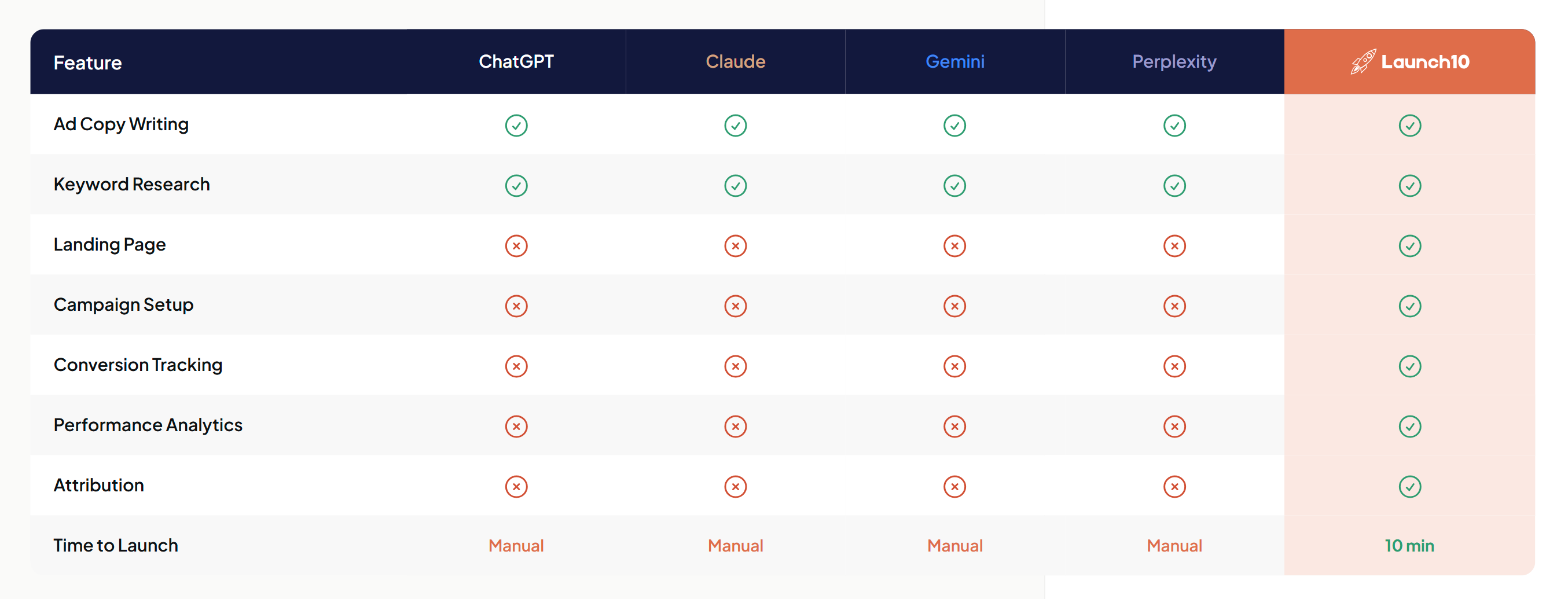
No chatbot can build and host a landing page, create a live Google Ads campaign, install conversion tracking, or close the attribution loop between ad spend and revenue. These four gaps are the reason businesses spend money on Google Ads and get nothing measurable in return.
1. Build and Host Your Landing Page
ChatGPT can write HTML. It can even generate a complete landing page layout with responsive CSS. But it cannot deploy that page to a server, configure SSL, connect a custom domain, ensure it loads in under three seconds on mobile, or make it pass Google’s Core Web Vitals checks.
This matters because Google Ads Quality Score — which directly affects how much you pay per click — is partly determined by your landing page experience. A page that loads slowly, looks broken on mobile, or doesn’t match the ad’s promise will increase your costs and decrease your results. For more on why this connection matters, read our guide on why your landing page and ads need to be connected.
You need somewhere to send your clicks. AI can write what goes on that page. It cannot make that page exist on the internet.
2. Set Up Conversion Tracking
This is the single biggest gap, and it is the reason most AI-assisted Google Ads campaigns fail. Without conversion tracking, you are paying for clicks with no way to know which ones become customers. You cannot optimize what you cannot measure.
ChatGPT can explain how to set up Google Tag Manager. It can walk you through creating conversion events. It can even generate the JavaScript snippets. But actually configuring tracking correctly — connecting Google Tag Manager to Google Ads, setting up conversion actions, ensuring events fire on form submissions and phone calls, debugging attribution windows — is where most businesses fail. WordStream’s analysis found that 29% of Google Ads accounts record zero conversions over 90 days, often because tracking was never properly configured.
The technical setup is not impossibly hard. It is fiddly, error-prone, and unforgiving. One misconfigured trigger means your data is wrong, and you won’t know it’s wrong until you’ve spent hundreds of dollars optimizing toward the wrong signal. To understand why this matters so much, see our breakdown of why AI-generated Google Ads campaigns underperform.
3. Create and Manage a Campaign in Google Ads
The AI can suggest keywords and write copy. It cannot log into Google Ads, create a campaign, set up ad groups, configure keyword match types, set bid strategies, add negative keywords, manage budgets, or adjust bids based on performance.
Google Ads management is not a one-time task. It is an ongoing process of reviewing search term reports, adding negative keywords, adjusting bids, testing new ad variations, and pausing underperformers. Every week you are not doing this, your budget is leaking toward irrelevant clicks.
Someone who uses ChatGPT to write their ads still needs to learn the Google Ads interface, understand match types, and commit to weekly management. That is 5-10 hours per week that most business owners don’t have.
4. Connect the Dots: Which Ad Brought Which Customer
Even if you manually set up your landing page, configure conversion tracking, and build your campaign in Google Ads, you are still missing the most valuable piece of information: which keyword brought which customer.
This attribution loop — ad click to lead to customer to revenue — is what makes Google Ads worth the money. Without it, you know you got 50 clicks and 3 phone calls, but you don’t know which of your 20 keywords generated those calls. You can’t cut the keywords that waste money. You can’t double down on the ones that work.
End-to-end attribution requires integration between your ads, your landing page, your lead capture, and your CRM. No general-purpose AI tool can build that integration. It requires purpose-built software.
How the AI Tools Compare
When to Use ChatGPT (and When You Need More)
Use ChatGPT for writing and brainstorming; use a purpose-built platform when you need the full ads pipeline — landing pages, tracking, campaigns, and attribution — built and connected for you.
Use ChatGPT, Claude, or Gemini if you are an experienced marketer who already has a website with landing pages, Google Tag Manager configured, conversion tracking working, and the skills to build and manage campaigns in the Google Ads interface. In that case, AI tools are excellent writing assistants that will save you hours on copy and keyword research.
Use a purpose-built tool like Launch10 if you need customers, not just copy. If you don’t already have landing pages, tracking, and campaign management skills, the copy is the easy part. The hard part is everything that makes the copy actually work — and that is exactly what Launch10 automates.
Most people fall into the second category. They don’t need a better copywriter. They need the full pipeline: landing page, tracking, campaign, attribution, and ongoing optimization, all connected and working together from day one. One booked customer typically covers months of Launch10 at $59/month — whether that’s a $5,000 legal case, a $450 HVAC repair, or a $200 dental cleaning.
For a detailed side-by-side of what ChatGPT can and cannot do versus a purpose-built platform, see our ChatGPT vs. Launch10 deep dive. And if you are evaluating the broader landscape of AI-powered Google Ads tools, our AI Google Ads tools guide covers the full market.
The Bottom Line
ChatGPT, Claude, Gemini, and Perplexity are genuinely useful tools. They write good ad copy. They brainstorm solid keyword lists. They can save you hours on the creative side of Google Ads.
But Google Ads success is not a creative problem. It is an infrastructure problem. The businesses that make money from Google Ads are the ones that have every piece connected: the right keywords trigger the right ads, those ads send clicks to dedicated landing pages, those landing pages track every conversion, and those conversions are attributed back to the keywords that generated them.
General-purpose AI gives you the first piece. Launch10 gives you all of them.
Behind the platform, Launch10 puts ten AI specialists on your account — from keyword researcher to tracking engineer to performance optimizer — all working together for less than one hour of agency time per month.
Keep Reading
- Why AI-Generated Google Ads Campaigns Underperform — the specific failure modes and how to avoid them
- ChatGPT vs. Launch10 for Google Ads — a detailed side-by-side comparison
- AI Google Ads Tools Guide — the full landscape of AI-powered Google Ads platforms
Related reading
- AI Google Ads tools guide — full landscape of AI tools for Google Ads
- Why AI-driven Google Ads campaigns underperform — common pitfalls in AI-built campaigns
- ChatGPT vs Launch10 — general-purpose AI vs purpose-built marketing AI
Frequently asked questions
Can ChatGPT create a Google Ads campaign?
Is it safe to let AI write my Google Ads?
What's the best AI tool for Google Ads?
Can I use ChatGPT and Launch10 together?
Do I need a landing page for Google Ads?

Co-Founder & CEO, Launch10
Greg Hockenbrocht is the Co-Founder and CEO of Launch10. Before Launch10, he was on the executive leadership team at Fundera through its acquisition by NerdWallet, where he led Growth & New Ventures following the company's IPO. Through Illuminated Ventures and work with founders and business owners, he saw a need for Launch10 to help bring clarity, confidence, and ease to digital marketing.