Best AI Tools for Google Ads in 2026

The AI Landscape for Google Ads Is Confusing. Here’s What Actually Works.
AI Google Ads tools fall into four categories: general-purpose chatbots (ChatGPT, Claude), Google’s built-in AI features (Smart Bidding, Performance Max), third-party optimization tools (Optmyzr, WordStream), and end-to-end campaign platforms (Launch10). The right choice depends on whether you need help with just ad copy, campaign optimization, or the entire campaign from landing page to conversion tracking.
Search for “AI Google Ads tools” and you will find hundreds of options. General-purpose chatbots that write ad copy. Google’s own AI features baked into the platform. Third-party optimization tools built for agencies. End-to-end campaign platforms that handle everything from landing page to live ads.
Every one of them claims to make Google Ads easier. But they solve different problems, for different people, at different price points. If you are trying to figure out which AI tool to use for Google Ads, this guide will save you hours of research.
We have tested, used, or evaluated every tool in this roundup. Here is what each category does well, where it falls short, and which one is the right fit for your situation.
Category 1: General-Purpose AI Chatbots
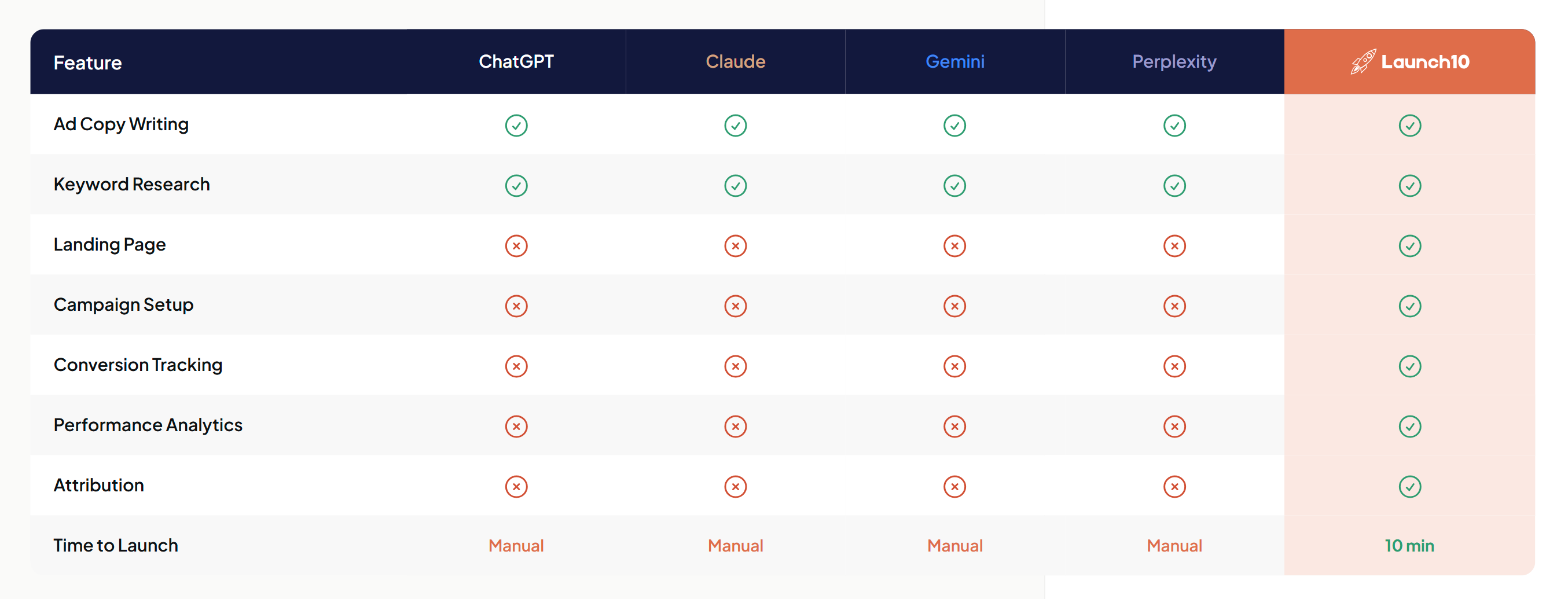
Chatbots like ChatGPT and Claude write ad copy and suggest keywords, but cannot create campaigns, build landing pages, or set up tracking.
Tools: ChatGPT, Claude, Gemini, Perplexity
These are the tools most people try first. You open ChatGPT, type “create a Google Ads campaign for my plumbing business,” and get back a solid set of headlines, descriptions, and keyword suggestions. It feels like magic — until you realize you still have no landing page, no conversion tracking, and no way to get those ads live without logging into Google Ads and building everything manually.
What they do well:
- Write ad headlines and descriptions quickly
- Brainstorm keyword ideas and long-tail variations
- Research competitor positioning and messaging gaps
- Explain Google Ads concepts in plain language
What they cannot do:
- Tell you actual search volume, cost per click, or keyword difficulty (they suggest keywords from training data, not live Google data)
- Build or host a landing page
- Create campaigns inside Google Ads
- Set up conversion tracking
- Manage bids or optimize performance over time
Each tool has its strengths. ChatGPT produces the most volume. Claude writes the most concise, usable copy. Gemini has access to Google’s data ecosystem. Perplexity cites its sources, which is useful for research. But none of them can tell you whether a keyword costs $2 or $40 per click, or whether 10 people search for it or 10,000. That distinction matters when real money is on the line. A 2025 field experiment published on SSRN found that fully AI-generated display ads achieved approximately 19% higher CTR than human-created controls, but CTR improvements mean nothing if clicks land on a page with no tracking. And WordStream’s 2026 study of 15,000 accounts found that 29% recorded zero conversions over a 90-day period, which means the copy quality is irrelevant — they cannot measure what happens after the click. We break down these differences in detail in our comparison of AI tools for Google Ads.
Best for: Experienced marketers who already have campaigns running and need a writing assistant.
Cost: Free to $20/month.
Verdict: Excellent for copy and research. Not a Google Ads management solution. If you use ChatGPT to write your ads but have no landing page or tracking, you are paying for clicks you cannot measure. For a deeper look at where chatbots stop and purpose-built tools start, read our ChatGPT vs. Launch10 comparison.
Category 2: Google’s Built-In AI Features
Google’s own AI tools (Smart Bidding, responsive ads, Performance Max) optimize existing campaigns but require you to set up the foundation — landing page, conversion tracking, and sufficient conversion volume — first.
Tools: AI Max campaigns, Performance Max, Smart Bidding, automatically created assets, AI-generated image ads
Google has invested heavily in AI features inside the Ads platform. Performance Max campaigns use machine learning to distribute your ads across Search, Display, YouTube, Gmail, and Maps. Smart Bidding adjusts your bids in real time based on conversion signals. Automatically created assets generate headline and description variations from your existing content.
These features are genuinely powerful — when you have the right foundation in place.
What they do well:
- Automate bid adjustments based on conversion data
- Generate ad variations automatically from your inputs
- Expand keyword targeting through broad match plus AI
- Distribute ads across multiple Google properties
What they cannot do:
- Build your landing page
- Set up conversion tracking — you need to do this before any of the AI features work properly
- Perform well without sufficient conversion data (Smart Bidding needs 30 to 50 conversions per month minimum)
- Replace campaign strategy — they optimize execution, not direction
Here is the problem most small businesses hit: Google’s AI features optimize toward whatever you tell them to optimize for. If you have conversion tracking set up correctly, they optimize for customers. If you do not, they optimize for clicks. And clicks without conversions is just spending money faster with no way to know if it is working.
Best for: Businesses already running campaigns with solid conversion tracking and enough monthly volume to feed the algorithm.
Cost: Free — included in Google Ads.
Verdict: The most powerful optimization tools available, but they require existing infrastructure. Without conversion tracking and a decent landing page, Performance Max and Smart Bidding will spend your budget efficiently on the wrong things.
Category 3: Third-Party Google Ads Optimization Tools
Tools like Optmyzr and WordStream automate bid management and reporting for existing campaigns, typically starting at $100-500/month.
Tools: Optmyzr, Adalysis, WordStream
These tools sit on top of Google Ads and help you manage, audit, and optimize existing campaigns. They are built for marketers and agencies who manage multiple accounts and need automation at scale.
Optmyzr is the most full-featured. It offers rule-based automation, budget pacing, quality score tracking, and one-click optimizations. It is the tool most agencies use. Pricing starts around $208/month.
Adalysis focuses on ad testing and quality score optimization. It automatically identifies underperforming ads and suggests replacements. It is less broad than Optmyzr but deeper on creative testing. Plans start around $99/month.
WordStream (now part of LocaliQ) offers a simpler interface with a “20-minute work week” approach — it surfaces the highest-impact recommendations and lets you apply them quickly. It is the most accessible of the three, though it has shifted toward being a lead-gen tool for LocaliQ’s agency services.
What they do well:
- Audit existing campaigns for wasted spend and missed opportunities
- Suggest bid adjustments and negative keywords
- Automate reporting and performance alerts
- Manage multiple accounts from a single dashboard
What they cannot do:
- Create campaigns from scratch
- Build landing pages
- Set up conversion tracking
Best for: Agencies and experienced advertisers managing multiple accounts who need efficiency tools.
Cost: $100 to $500+ per month.
Verdict: Valuable for optimization at scale. Overkill — and often confusing — for a single small business running one or two campaigns. These tools assume you already know how to run Google Ads. They make good campaigns better. They do not make campaigns exist.
Category 4: End-to-End AI Campaign Platforms
Tool: Launch10
This is the category we built Launch10 to fill. The gap we kept seeing was simple: most people do not need better ad copy or smarter bid management. They need the entire pipeline — from “I have a business” to “I have a live Google Ads campaign that tracks which ads produce customers” — handled in one place.
What Launch10 does:
- AI generates your landing page with copy, design, and calls to action tailored to your business
- Creates ad headlines, descriptions, and keyword targeting
- Builds and manages your Google Ads campaign
- Sets up conversion tracking automatically — no code, no Google Tag Manager
- Provides an attribution dashboard showing which ad produced which lead
- Goes from idea to live campaign in under 10 minutes
Launch10 is a purpose-built AI platform — it uses AI at every step, from generating your landing page to selecting keywords from real search data to optimizing your campaign based on performance. The difference from ChatGPT is not AI vs. no AI. It is AI applied to writing vs. AI applied to the entire campaign: the landing page, the tracking, the ads setup, and the connection between them.
Best for: Business owners and home services companies who need customers, not marketing tools.
Cost: $59 to $299/month, which includes landing page hosting, ad management, and analytics.
Verdict: The only tool that handles the complete pipeline. No other tools, expertise, or manual setup required. One booked customer typically covers months of Launch10 at $59/month — whether that’s a $5,000 legal case, a $450 HVAC repair, or a $200 dental cleaning. If your ads are already running but underperforming, our diagnostic guide can help you identify what is going wrong.
Decision Matrix: Which Tool Fits Your Situation?
| What you need | Best option |
|---|---|
| Help writing ad copy and headlines | ChatGPT or Claude (free) |
| Optimizing campaigns that are already running well | Google AI features + Optmyzr |
| Launching Google Ads from scratch as a small business | Launch10 |
| Agency-level management across multiple accounts | Optmyzr or Adalysis |
| Figuring out if your current campaigns are actually working | Launch10 or WordStream |
What to Look For in an AI Google Ads Tool
Not all AI tools solve the same problem. Before you choose one, ask these four questions:
1. Does it handle landing pages, or just ads? An ad without a landing page is a click that goes nowhere useful. If a tool writes great ad copy but leaves you to figure out where those clicks land, you are solving half the problem. The tools that deliver results connect the ad to a page built for conversion.
2. Does it set up conversion tracking? This is the biggest gap in the market. Most AI tools — including Google’s own features — assume conversion tracking is already in place. For small businesses, it almost never is. If a tool does not handle tracking, every dollar you spend is unaccounted for.
3. Can it show you which ads produce customers, not just clicks? Click-through rate is a vanity metric. What you need is attribution: this ad generated this lead who became this customer. Tools that stop at clicks leave you guessing about what is actually working.
4. How long does it take to go from zero to live? If you need a week of setup, three integrations, and a marketing certification to launch a campaign, the tool is built for marketers, not business owners. The best tools for small businesses get you live fast and improve from there.
The Bottom Line
The AI landscape for Google Ads is crowded, but the categories are clear. Chatbots help you write. Google’s AI helps you optimize. Third-party tools help agencies manage at scale. End-to-end campaign platforms help small businesses launch and run campaigns without needing to become Google Ads experts.
Most small businesses do not need more tools — they need fewer tools that do more. If you are evaluating your options, start with our complete guide to AI for Google Ads, which goes deeper on how each approach works and where the gaps are.
Related reading
- AI for Google Ads — AI marketing primer for Google Ads operators
- Why AI-driven Google Ads campaigns underperform — common pitfalls in AI-driven setups
- AI landing page builders for Google Ads — page-builder side of the AI tool landscape
- Can you vibe-code a Google Ads campaign? — where AI-assisted campaign building helps and where it breaks
Frequently asked questions
What's the best free AI tool for Google Ads?
Do I need an AI tool to run Google Ads?
Can Google's AI features replace a marketing agency?
How much should a small business spend on Google Ads tools?
What's the difference between Google Ads AI and third-party AI tools?

Co-Founder & CEO, Launch10
Greg Hockenbrocht is the Co-Founder and CEO of Launch10. Before Launch10, he was on the executive leadership team at Fundera through its acquisition by NerdWallet, where he led Growth & New Ventures following the company's IPO. Through Illuminated Ventures and work with founders and business owners, he saw a need for Launch10 to help bring clarity, confidence, and ease to digital marketing.