
Plumber Marketing: The Lead-Generation Stack for Service Plumbers

Plumber marketing in 2026 is won in three places: Google Business Profile, Google Local Services Ads, and a website that converts phone-shy visitors into calls. Everything else — Facebook, truck wraps, door hangers, magnets on the fridge — is either a supporting asset or a distraction, depending on the business’s size. This guide covers how to build the lead-generation stack that keeps a plumbing business busy year-round, not just during emergency seasons.
The payoff for getting marketing right in plumbing is direct and measurable. A properly set-up Google Business Profile and Local Services Ads account can produce 30–100 service calls a month in most mid-sized cities, at a cost per call that lets the business grow instead of just survive.
Why Plumber Marketing Is Different from Other Service Businesses
Plumbing is the highest-intent home service category — nobody searches for “plumber near me” out of curiosity. That intent profile shapes every marketing decision.
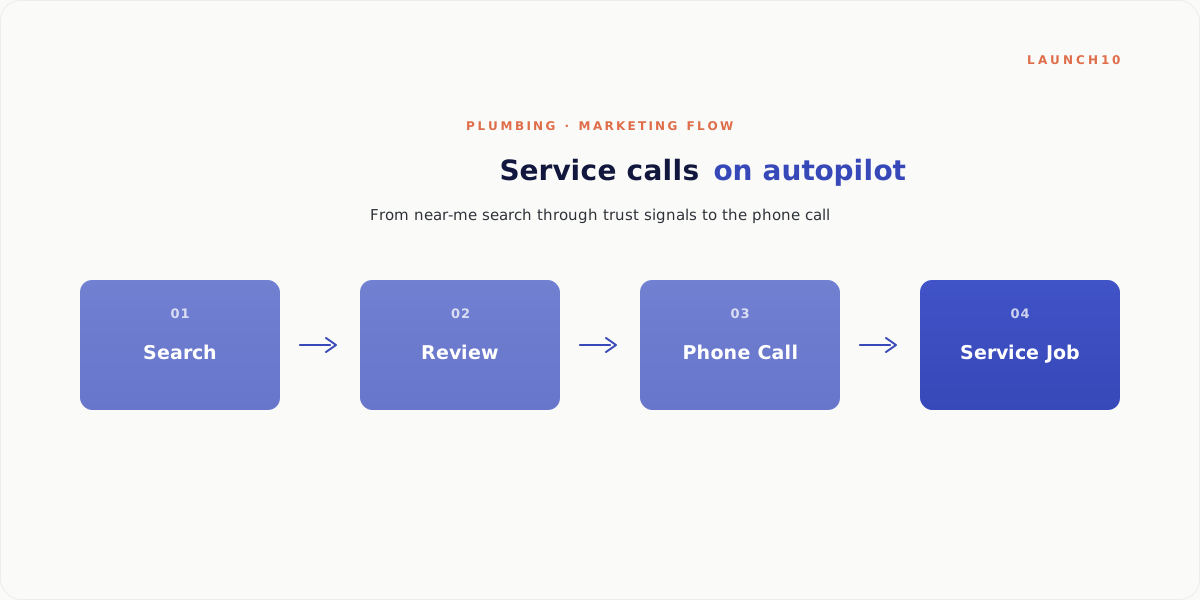
Three things make plumbing unique. First, the buyer is almost always in distress when they search. A clogged drain, a leaking water heater, a burst pipe — these aren’t planned purchases. Speed of response often matters more than price, brand, or review count. The plumber who picks up the phone on the first call usually wins the job.
Second, emergency and planned services have completely different buyer behaviors and margins. Emergency-intent leads (burst pipe, failed water heater) convert at substantially higher rates because the customer has no alternative in the moment. Planned-service leads (water softener install, remodel work) convert at lower rates because the customer is comparison shopping. Both need marketing, but they need different marketing.
Third, reviews and the “Google Verified” badge do heavy lifting. A business with substantial recent reviews at 4.5+ stars and an active Google Verified listing gets called at dramatically higher rates than an unverified competitor with the same ad budget. Trust signals matter more in plumbing than in almost any other home service because the job involves letting a stranger into your house during a crisis.
The Channels That Actually Drive Service Calls
For most plumbing businesses, 85%+ of measurable leads come from four channels. In rough order of payoff:
- Google Local Services Ads (LSAs). Pay-per-lead instead of pay-per-click, appear above Google Ads and organic results, and require Google Verified certification. For most plumbers, LSAs are the single highest-ROI paid channel and should be running before anything else paid.
- Google Business Profile (GBP). A fully optimized GBP with weekly posts, service categories, photos of real jobs, and 100+ reviews captures the majority of “plumber near me” searches. Free to run, massive to ignore.
- Google Ads on emergency and service-specific keywords. Targeting “water heater replacement,” “emergency plumber [city],” “burst pipe repair” captures high-intent traffic that LSAs can’t absorb when lead volume is capped — getting started with Google Ads covers the campaign fundamentals.
- Review generation and reputation management. Automated review workflows materially increase review volume; Birdeye reports that Complete Care grew reviews per location by 3,653% after automating review requests. BrightLocal’s 2026 Local Consumer Review Survey finds 97% of consumers read reviews for local businesses — review volume compounds the effectiveness of every other channel.
Below those four: Facebook ads can work for planned services (remodels, water treatment) but rarely for emergency. Nextdoor delivers local leads but volume is modest. Yelp still produces for some businesses but the ROI has declined steadily as GBP has improved.
LSAs vs. Google Ads: Where Each Wins
For most plumbers, LSAs should be maxed out before Google Ads scales up. Then Google Ads fills the gap when LSAs run out of capacity.
| Factor | Local Services Ads | Google Ads |
|---|---|---|
| Pricing model | Per qualified lead | Per click |
| Position on results page | Top, above everything | Below LSAs, above organic |
| Trust signal | Google Verified badge included | No badge |
| Lead quality | High (Google screens) | Variable (depends on targeting) |
| Max daily lead cap | Yes (you set it) | No (budget caps only) |
| Setup complexity | Moderate (verification required) | Moderate |
Cost per lead varies by market and service. WordStream’s 2025 benchmark data for Home & Home Improvement averages $90.92 CPL across paid search; LSAs trend lower than Google Ads in most plumbing markets because Google’s verification and pay-per-lead model filter out lower-quality clicks.
The strategic move for most plumbers is to run LSAs at their maximum daily lead cap and then use Google Ads to capture demand that LSAs couldn’t serve. Running Google Ads before maxing LSAs is almost always more expensive per lead than it needs to be.
What a Converting Plumber Landing Page Needs
A plumber’s landing page has one job: make the phone ring in the next 30 seconds. Every design and copy choice should serve that job.
Most plumbing websites fail because they try to be a brochure. Brochures are for businesses whose customers do research. Plumbing customers, especially emergency customers, do not do research — they call whoever answers.
Landing pages that produce calls share a predictable structure:
- Phone number above the fold, everywhere on mobile. Sticky header, large, tap-to-call. Not a contact form. The fastest-converting plumbing pages are almost one giant phone button.
- Service-matched headline. If the ad was “Emergency Plumber [City] — 24/7,” the landing page headline says exactly that. Generic “We fix everything” headlines underperform specific “We fix exactly what you searched for” headlines every time.
- Trust stack near the fold. Google Verified badge (if you have LSAs), BBB rating, years in business, insured and licensed language, a headshot of the owner, and at least one recent review quoted with a photo.
- Response time promise. “Someone will pick up in under 60 seconds” or “Same-day service available” converts because customers have already been sent to voicemail by another plumber that hour.
- No unnecessary navigation. A landing page is not the homepage. Strip the menu to service options only. Don’t link out to About or Blog pages that give the visitor an exit.
Dedicated landing pages consistently outperform homepages on paid traffic. Unbounce’s 2025 Conversion Benchmark Report puts the median landing-page conversion rate across industries around 6.6%. Plumbing businesses that rebuild paid-traffic landing pages around the rules above consistently see meaningful call-volume lift from the same ad spend — typically the largest single ROI improvement available in the marketing system.
This applies directly to the thesis covered in why connecting your ads and landing pages matters.
Tracking That Tells You What’s Actually Working
Most plumbing businesses can tell you their monthly marketing spend. Few can tell you cost per booked job by channel. That gap is where money leaks.
The tracking stack doesn’t need to be fancy, but it needs to exist:
- Call tracking numbers per channel. Different numbers for LSAs, Google Ads, GBP, direct mail — so when a call comes in, you know which channel produced it.
- Conversion events on qualified calls. Use call duration as one qualification signal alongside outcome tagging and manual review — CallRail and similar platforms support custom qualification workflows rather than a single universal duration threshold.
- Job status captured in dispatch software. Every call gets tagged booked / not-booked / rescheduled, so call-to-booking rates become visible per channel.
- Monthly reconciliation. Marketing spend by channel against booked jobs by source, reviewed on the same day every month.
Plumbing businesses that install this stack usually find that one or two channels are doing 60–80% of the real work, and they can either pour more into those or fix the channels that aren’t producing. Without it, every “is our marketing working” conversation becomes an opinion contest.
For the specific mechanics of setting this up for paid channels, our Google Ads conversion tracking setup guide covers each step.
Common Plumber Marketing Mistakes
The decisions that routinely cost plumbing businesses the most:
- Running Google Ads before LSAs. You’re almost certainly overpaying per lead. Max LSAs first.
- Ignoring GBP. A neglected Google Business Profile is a closed sign on your busiest storefront.
- No call tracking. Without it, reallocation decisions are coin flips.
- Landing pages that try to be websites. Every extra link is an exit.
- Waiting for customers to leave reviews on their own. Systematic review requests via text produce far more reviews than waiting for customers to act on their own.
- Discounting instead of differentiating. Race-to-the-bottom pricing attracts customers who don’t recommend you. Trust-based positioning attracts customers who do.
For the Google-Ads-specific tactical playbook — keyword selection for emergency vs. planned services, call-tracking setup, and plumbing landing page essentials — see our companion guide on Google Ads for plumbers.
Launch10 — Built for Plumbers Who Want the Phone to Ring, Not a Marketing Project
We built Launch10 for the plumbing operator — and the agencies serving them — whose actual job is fixing pipes, not learning Google Ads. People asked us for dispatch software, route optimization, and parts inventory tools constantly; we said no. ServiceTitan and Housecall Pro already do that work. We built the opposite: a single connected system that handles the landing page and the Google Ads campaign and the conversion tracking and the attribution dashboard.
Here’s what that gets a plumbing business running paid search:
- Real ad cost data baked in, not guessed. Live keyword cost and competition for your service area — emergency vs. planned-service CPCs are very different, and most plumbers bid them the same.
- Pages built to win Quality Score. Sub-second LCP, mobile-first, zero bloat — the boring stuff Google rewards with cheaper clicks, which matters when a single emergency click can run $20+.
- Service-specific landing pages and Google Ads generated together (emergency, water heater, drain cleaning, sewer line), on every plan including Starter.
- Click-to-call tracking out of the box. Call tracking by channel, GCLID, conversion events, and dollar attribution so you can answer “cost per booked job by channel” — the question most plumbing operators can’t answer today.
- Leads delivered wherever you already work. ServiceTitan, Housecall Pro, Jobber, your dispatcher’s inbox — plus 5,000+ apps via Zapier.
This is not a field-service platform. We run the marketing layer that turns Google Ads spend into booked service calls.
Best for: Plumbing operations running $3K–$15K/month in paid ads, plus the agencies and in-house marketers serving them.
Related reading
- Google Ads for plumbers — the tactical campaign-build companion
- Plumber lead generation — exclusive vs. shared-lead economics
- Connecting landing pages to ads — what most plumbing websites get wrong on the ad-to-page handoff
Frequently asked questions
What's the best marketing for a plumbing company?
How much should a plumber spend on marketing?
What's a good cost per lead for plumbing companies?
Do Local Services Ads (LSAs) work for plumbers?

Co-Founder & CEO, Launch10
Greg Hockenbrocht is the Co-Founder and CEO of Launch10. Before Launch10, he was on the executive leadership team at Fundera through its acquisition by NerdWallet, where he led Growth & New Ventures following the company's IPO. Through Illuminated Ventures and work with founders and business owners, he saw a need for Launch10 to help bring clarity, confidence, and ease to digital marketing.