
Plumber Lead Generation: Sources and Intake That Closes

Plumber lead generation is the part of plumbing marketing most businesses get structurally wrong — not because they pick the wrong channels, but because they treat every lead source the same way, measure only total lead volume, and pay for intake response times that kill close rates before the first conversation. This guide goes deeper than channel selection: it’s about evaluating lead quality by source, understanding why a 30-second delay in callback drops close rate by half, and deciding which aggregator leads are worth paying for and which are burning budget.
If you’ve already read our plumber marketing guide, this is the companion piece that focuses on the supply-side question: once a lead arrives, how do you tell if it’s worth pursuing, and how do you close it at a rate that makes the channel cost-effective?
What “Lead Generation” Actually Means for a Plumbing Business
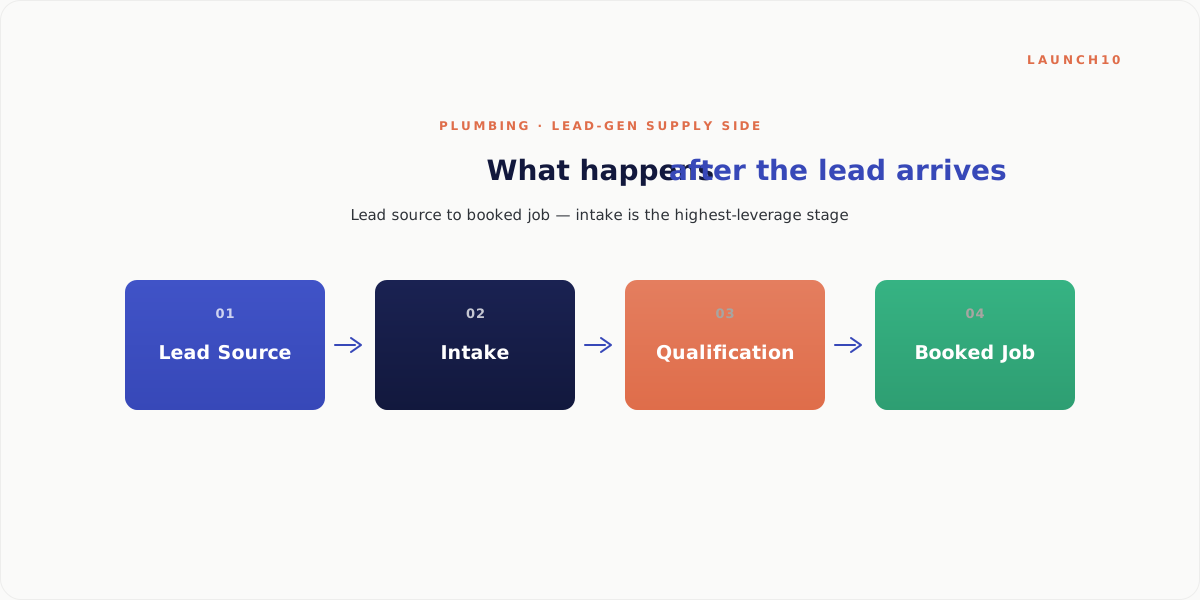
Lead generation isn’t a single activity — it’s four distinct problems stacked together: lead sourcing, lead qualification, intake response, and close-rate optimization. Most plumbers think they have a marketing problem when they actually have an intake problem.
Consider two identical plumbing businesses. Both spend $6,000 a month on Google Local Services Ads. Both get 80 qualified leads a month. Business A has a trained intake specialist who answers every call in under 45 seconds, qualifies the lead in 2 minutes, and books an appointment in 65% of calls. Business B routes calls to a voicemail after-hours and to whichever tech is free during the day. Business B books 25% of calls.
Same lead source, same spend, same volume — and Business A produces 52 booked jobs while Business B produces 20. The lead-generation problem isn’t the leads. It’s everything that happens in the first few minutes after the phone rings.
Most plumbing marketing content focuses on lead sourcing because that’s the visible work. The invisible work — how leads get answered, qualified, and closed — is where the money gets won or lost.
Lead Sources Ranked by Quality, Not Just Volume
Not all plumbing leads are worth the same thing. A lead from your own Google Ads converted via a well-matched landing page is worth roughly 2–3× an aggregator lead, because it’s exclusive, higher-intent, and reaches you faster.
Here’s how the major plumbing lead sources actually compare on quality:
| Source | Lead exclusivity | Relative close rate | Relative cost per signed job |
|---|---|---|---|
| Your own Google Ads + landing page | Exclusive | High | Lower (when intake is fast) |
| Google Local Services Ads | Exclusive | High | Lower |
| Google Business Profile | Exclusive | Very high | Lowest (free channel) |
| Referral from existing customer | Exclusive | Highest | $0 direct |
| HomeAdvisor / Angi / Networx | Shared among multiple providers | Low–moderate | Often highest on cost-per-signed-job basis |
| Thumbtack | Varies by category | Moderate | Variable |
| Nextdoor recommendations | Exclusive | Moderate–high | Variable |
For broader category benchmarks, WordStream’s 2025 Google Ads data shows Home & Home Improvement averaging $90.92 CPL and $7.85 CPC — and running Google Ads the right way covers the campaign-building basics behind those numbers. Actual close rates and cost-per-signed-job numbers vary significantly by market and should be measured against your own tracked data.
Two insights jump out of that table. First, cost per lead and cost per signed job are different numbers, and the ranking changes between them. Aggregator leads look cheap on a cost-per-lead basis and often end up most expensive on a cost-per-signed-job basis because close rates are so much lower. Second, GBP is nearly always the cheapest real channel once you account for close rate — which is why practitioners who obsess about it tend to outperform those who don’t.
Interactive · Cost-Per-Signed-Job Calculator
What are your leads actually costing you?
Cost per lead is the input metric. Cost per signed job is the outcome. Enter your numbers and compare against the two channel archetypes below.
Your inputs
$80 per lead · 40% close rate
Cost per signed job
$200
Typical direct channel (LSA, GBP, own Google Ads)
$75 per lead · 55% close rate
Cost per signed job
$136
Typical shared aggregator (HomeAdvisor, Angi)
$45 per lead · 15% close rate
Cost per signed job
$300
Formula: cost per signed job = cost per lead ÷ close rate. Comparison scenarios are illustrative archetypes based on channel dynamics described in the article; your actual numbers will vary by market, service, and intake speed.
The Intake Response Problem
Callback speed is the most undermeasured and highest-ROI variable in plumbing lead generation. Responding within 5 minutes makes a firm about 21 times more likely to qualify a lead than waiting 30 minutes, according to the widely-cited Lead Response Management Study led by James Oldroyd.
Harvard Business Review’s 2011 analysis found that firms responding within an hour were roughly 7 times more likely to qualify a lead than those waiting longer. The math follows directly from customer behavior: a homeowner with a leaking pipe who submits a form or calls and doesn’t reach a plumber immediately will call two or three others within minutes. The business that answers first usually wins the job.
Interactive · Response Time Impact
How fast is fast enough?
Drag the slider to your typical lead-response time. See how much your qualification rate changes versus a 30-minute baseline.
vs the 30-minute baseline in HBR's 2011 response-time study
Sub-5-minute response — ~21× more likely to qualify than 30-min response
Source: Oldroyd, McElheran, and Elkington, "The Short Life of Online Sales Leads," Harvard Business Review (2011). Decay curve interpolates between published anchors; your actual qualification lift depends on lead source, industry, and intake quality.
The intake response improvements that actually move the needle:
- Answer every call live during business hours. Not an auto-attendant. Not a menu. A real person by the third ring. Most plumbing businesses lose more revenue to missed calls than they lose to any other operational problem.
- Call back web-form leads within 5 minutes. Set up a system that alerts whoever is responsible the moment a form submits. Per the studies above, sub-5-minute responses are ~21× more likely to qualify than 30-minute responses (Lead Response Management Study), and within-hour responses are ~7× more likely to qualify than those waiting longer (HBR, 2011).
- After-hours coverage. Either a rotating on-call tech who answers emergency calls directly, or a dedicated answering service that can dispatch. Routing to voicemail after-hours loses the majority of those leads to competitors who answer.
- Follow-up on leads that didn’t answer the initial call. Most plumbers try once and move on. Three call attempts spaced 10 minutes, 1 hour, and 24 hours apart increase close rate significantly at almost no cost.
Businesses that install these four basics typically see close rates climb 15–30 percentage points within a quarter — from the same leads, at the same lead cost.
Why Aggregator Leads Underperform (and When They’re Still Worth It)
HomeAdvisor, Angi, and Networx typically sell the same lead to multiple competing plumbers simultaneously. That single design choice explains why aggregator leads look cheap on a per-lead basis and convert poorly on a per-signed-job basis.
When a customer fills out a form on HomeAdvisor, the platform routes that form to multiple local plumbers at the same time. The plumber who calls back first usually wins. The others pay for the lead and get nothing. That shared dynamic is why aggregator leads consistently convert worse than exclusive channels — not because the leads are bad, but because you’re competing against other plumbers who received the same lead at the same moment.
That dynamic changes the evaluation criteria for aggregator spending:
- Cost per lead is misleading. Illustrative example: a cheap aggregator lead at a low close rate can easily cost more per signed job than a more expensive direct-channel lead at a high close rate. Always compare sources on the outcome metric (cost per signed job), not the input metric (cost per lead).
- Aggregator leads make sense for filling capacity, not building pipeline. If your trucks have gaps and your direct channels are saturated, aggregator leads can absorb the slack. They’re a capacity filler, not a pipeline backbone.
- Speed advantage matters even more for aggregator leads. Since you’re racing other providers for the same lead, being the first to respond is the only way to make the economics work.
- Negotiate credits for unqualified leads. Every aggregator platform has a process for disputing wrong-number or out-of-area leads. Lead auditing and dispute workflows can reduce waste on low-quality marketplace leads — most plumbers don’t bother, so there’s usually meaningful recoverable spend here.
Tracking That Makes Lead-Source Decisions Obvious
Most plumbing businesses track cost per lead. The businesses that scale efficiently track cost per signed job, by source, and reallocate monthly based on the outcome metric.
The tracking stack for a modern plumbing operation:
- Unique phone numbers per lead source. LSAs, Google Ads, GBP, HomeAdvisor, Angi, direct mail — each with a different tracked number. Inbound calls become self-attributing.
- Lead-source field captured at intake. The person answering asks or observes the source and logs it in the CRM.
- Close-status tagging through the sales pipeline. Every lead tagged answered / qualified / booked / signed / lost / referred.
- First Monday review. Marketing spend by source against signed-job revenue by source, reviewed the same day every month.
Operations that install this stack almost always find that one or two channels are dramatically more efficient than assumed and one or two are dramatically less. Reallocating based on real data reliably improves efficiency — better booked-job volume per marketing dollar — which is the point of the tracking in the first place.
For the specific mechanics of setting up call tracking and conversion events, our Google Ads conversion tracking guide walks through each step, and why Google Ads aren’t generating leads covers the common pitfalls.
Common Lead-Generation Mistakes
The decisions that routinely cost plumbing businesses the most:
- Treating every lead source the same way. Different sources deserve different intake priorities and different evaluation metrics.
- Measuring cost per lead instead of cost per signed job. The ranking changes completely on the outcome metric.
- Slow or inconsistent callback on web-form leads. The highest-leverage ten minutes of your week.
- Continuing to buy aggregator leads without measuring close-rate drag. If close rates are 3× lower on a channel, cost per lead has to be 3× lower for the economics to work.
- Routing after-hours leads to voicemail. Emergency plumbing is the business. After-hours is when intent is highest.
- Failing to dispute bad aggregator leads. Leaving 10–20% of that spend on the table that could be credited back.
- Chasing new lead channels before fixing intake. A new channel with your current intake performance delivers your current close rate at the new channel’s price.
Launch10 — Built for Plumbers Who Want Exclusive Leads, Not a Slice of a Shared One
We built Launch10 for the plumbing operator — and the agencies serving them — who’s tired of paying aggregators for leads that go to three other plumbers in the same hour. People asked us for shared-lead marketplaces and pay-per-call aggregator integrations constantly; we said no. Angi, HomeAdvisor, and Thumbtack already do that — and that’s the model you’re trying to escape. We built the opposite: a single connected system that handles the landing page and the Google Ads campaign and the conversion tracking and the attribution dashboard, so the lead is yours alone.
Here’s what that gets a plumbing business running paid search:
- Real ad cost data baked in, not guessed. Live keyword cost and competition for your service area — so you can compare exclusive-lead economics to aggregator economics on the same dashboard.
- Pages built to win Quality Score. Sub-second LCP, mobile-first, zero bloat — the boring stuff Google rewards with cheaper clicks.
- Service-specific landing pages and Google Ads generated together (emergency, water heater, drain cleaning, sewer line), on every plan including Starter.
- Click-to-call tracking out of the box. Call tracking by channel, GCLID, conversion events, and dollar attribution so you can answer “cost per booked job — exclusive vs. shared” in one view.
- Leads delivered wherever you already work. ServiceTitan, Housecall Pro, Jobber, your dispatcher’s inbox — plus 5,000+ apps via Zapier.
This is not a lead aggregator. We run the marketing layer that lets you generate your own exclusive leads, on your own pages, with your own brand.
Best for: Plumbing operations running $3K–$15K/month in paid marketing who are ready to shift the mix from shared to exclusive, plus the agencies and in-house marketers serving them.
Related reading
- Plumber marketing — the full channel mix — broader companion to this lead-gen-focused piece
- Google Ads for plumbers — the tactical campaign-build companion
- Why your Google Ads aren’t generating leads — diagnose campaigns before paying for more leads
Frequently asked questions
Where do the best plumber leads come from?
What's a realistic lead-to-job conversion rate for plumbers?
How fast do I need to call back a plumber lead?
Should I stop using HomeAdvisor and Angi as a plumber?

Co-Founder & CEO, Launch10
Greg Hockenbrocht is the Co-Founder and CEO of Launch10. Before Launch10, he was on the executive leadership team at Fundera through its acquisition by NerdWallet, where he led Growth & New Ventures following the company's IPO. Through Illuminated Ventures and work with founders and business owners, he saw a need for Launch10 to help bring clarity, confidence, and ease to digital marketing.