
Personal Injury Lawyer Marketing: The Cost-Per-Case Playbook

Personal injury marketing sits at the expensive end of legal PPC. WordStream’s 2025 Google Ads benchmark data shows Attorneys & Legal Services at $8.58 average CPC — the highest of any industry — and PI keywords routinely exceed that category average in competitive cities. The firms that win at this marketing don’t spend less than their competitors. They convert more of what they spend, because their intake, landing pages, and tracking turn qualified clicks into signed cases while their competitors waste budget on leads that never return a call.
This guide is written for PI firms that want to stop buying leads and start building a marketing system: which channels actually produce signed cases, what a converting PI landing page looks like, how to track cost per case instead of cost per click, and how to avoid the agency retainer traps that cost the industry millions every year.
Why Personal Injury Marketing Is a Different Game
PI marketing is governed by economics most legal verticals don’t face: multi-thousand-dollar click costs, months-long case timelines, and intake systems that make or break every ad dollar.
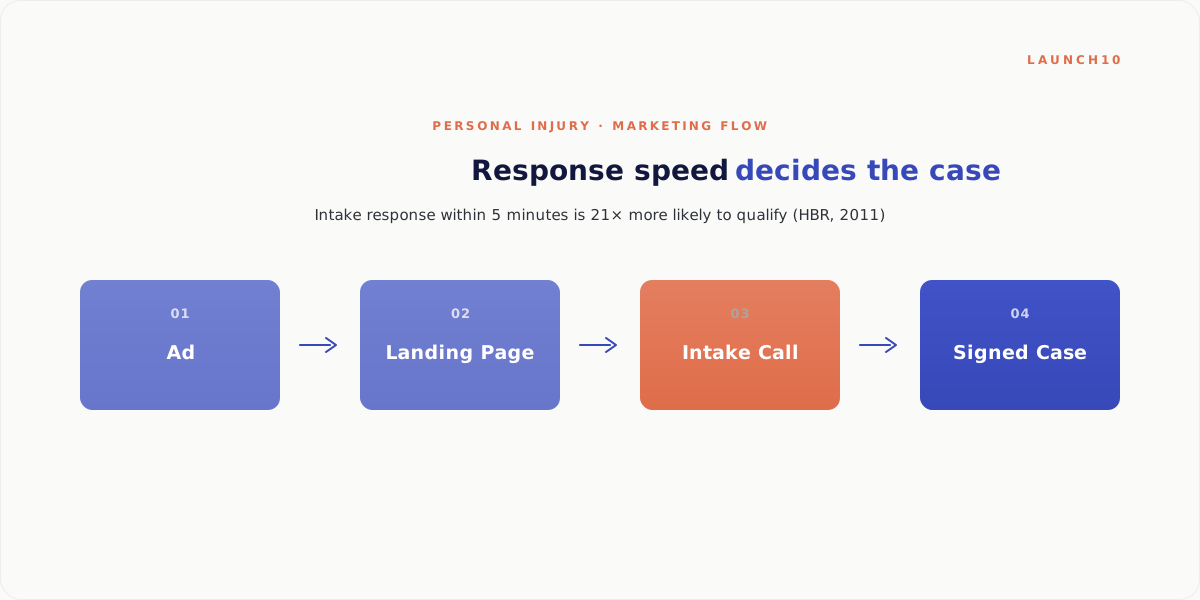
At category-leading CPCs, there’s no margin for sloppy landing pages, slow intake response, or vague tracking. A firm that takes four hours to return a lead’s call has already lost that lead to a competitor who answered in minutes. The Lead Response Management Study (led by James Oldroyd) found that firms responding to web leads within 5 minutes were about 21 times more likely to qualify a lead than those waiting 30 minutes — the kind of response-speed gap that decides which firm wins a case at current ad prices.
Case value changes the math in the other direction. Contingency-fee recoveries on auto-accident and serious-injury cases can materially exceed the lead acquisition cost that would be reckless in almost any other industry. High-severity matters can be economically significant enough that firms tolerate much higher per-case acquisition costs than in lower-value verticals — provided the intake and close rates support the math. Calculate your own ceiling from average case economics rather than relying on a generic industry range.
The variable that decides whether those numbers work is intake. Two firms running identical Google Ads budgets with identical landing pages can have 5× different cost-per-signed-case numbers because one answers calls within minutes with a trained intake specialist and the other routes to voicemail after hours. The Lead Response Management Study (led by James Oldroyd) found that firms responding within 5 minutes were about 21× more likely to qualify a lead than those waiting 30 minutes.
Interactive · Response Time Impact
How fast is fast enough?
Drag the slider to your typical lead-response time. See how much your qualification rate changes versus a 30-minute baseline.
vs the 30-minute baseline in HBR's 2011 response-time study
Sub-5-minute response — ~21× more likely to qualify than 30-min response
Source: Oldroyd, McElheran, and Elkington, "The Short Life of Online Sales Leads," Harvard Business Review (2011). Decay curve interpolates between published anchors; your actual qualification lift depends on lead source, industry, and intake quality.
The Channels That Produce Signed PI Cases
Most PI firms running marketing at $30K+/month will get 90% of their signed cases from four channels. In rough order of payoff for small-to-mid firms:
- Google Ads on service-specific keywords. Not “lawyer” — “car accident lawyer [city],” “truck accident attorney [city],” “[specific injury type] lawyer.” Narrower keywords have higher intent and lower competition than brand-category terms — Google Ads fundamentals for small firms covers account structure and tracking.
- Google Business Profile. The “near me” search pattern has grown faster than any other legal search category. A complete GBP with case results, attorney bios, 50+ reviews, and weekly posts captures clients who would otherwise go to the firm with the bigger GBP.
- Attorney referral networks. Every firm should be on speaking terms with estate, family, and corporate attorneys in their market — they see people who got hurt but aren’t being served by their own practice. Referral partnerships with professional peers can be a valuable lower-CAC case source, but output varies substantially by firm and market. The shared economic condition is reciprocity: firms that pay referral fees promptly and refer back consistently do meaningfully better than those that don’t.
- Reputation and reviews. A 4.6-star, 200-review firm beats a 4.9-star, 20-review firm in almost every contest. Volume of reviews signals volume of clients served, which is exactly the social proof PI clients are looking for.
Channels that produce for big brand firms but rarely pencil out for small firms: TV, billboards, radio, and sponsored attorney directories. These can work with the budget to saturate a market — but they starve without it, and most small firms don’t have the budget to saturate.
What a Converting PI Landing Page Needs
The job of a PI landing page is to get someone in a terrible moment of their life to call your firm in the next five minutes. Everything on the page should serve that.
Generic legal landing pages — the kind most template tools produce — fail PI because they treat the visitor like a researcher. PI visitors aren’t researching. They’re in pain, they’re scared, and they’re choosing fast. The page should:
- Match the ad’s language exactly. If the ad said “Free car accident consultation,” the page’s first sentence should say “Free car accident consultation.” Any gap makes the visitor doubt they’re in the right place.
- Show the phone number everywhere. Top of page, middle, bottom, and sticky on scroll. PI visitors call. A contact form as the primary CTA will underperform a visible phone number every time.
- Include specific case results. Not just “Over $100 million recovered” — specific recent cases with settlement amounts, injury types, and city. Bar ethics rules constrain this differently by state; the compliant version still beats abstract claims.
- Establish a fast-response promise. “We answer the phone 24/7” or “Average response time: under 5 minutes” converts because PI visitors have already been ignored somewhere else in their life that week.
- Remove navigation. A landing page is not a website. Menus, footers linking to the About page, and social icons all invite the visitor to leave before calling. Strip them.
Dedicated landing pages consistently outperform homepages on paid traffic. Unbounce’s 2025 Conversion Benchmark Report puts the legal-services landing-page median conversion rate at about 6.3%, with the middle half of pages falling roughly between 4.4% and 8.6%. Firms that rebuild their paid-traffic landing pages around the rules above consistently land in the upper half of that range, which at PI click prices is the difference between an ad program that barely breaks even and one that runs profitably at scale.
This is the same principle covered in why connecting your ads and landing pages matters — it applies especially hard in PI because the click costs are so much higher.
Tracking What Actually Produces Signed Cases
Most PI firms can tell you their cost per click. Very few can tell you their cost per signed case. That gap is where the money is.
Cost per click is easy to measure and almost useless as a decision metric. Two campaigns with identical CPCs can have 10× different cost-per-signed-case numbers because of intake quality, landing page fit, and case-value mix. The firms that scale PI marketing profitably are the ones that reconcile marketing spend to signed cases every month.
The tracking stack isn’t complicated, but it takes intention to set up:
- Call tracking numbers on every landing page. A different number per service + campaign so you know which ad produced the call.
- Conversion events for qualified form submissions and phone calls. Use duration as one custom qualification signal alongside outcome tagging — public CallRail documentation emphasizes custom qualification workflows rather than a single universal duration threshold.
- Intake status tagging in your CRM. Every inquiry gets tagged as contacted / consulted / signed / declined / referred-out. Monthly, you can see what percentage of each channel’s leads became cases.
- Case source field in your case management system. When the case closes, the source flows back to marketing ROI analysis.
Without this, every conversation about “is our marketing working” becomes a faith argument. With it, the answer is a number your operations manager produces on the first Monday of every month.
For the mechanics of setting up conversion tracking, start with our Google Ads conversion tracking setup guide and our walkthrough of why Google Ads aren’t generating leads. Both apply directly to PI marketing.
The Common Mistakes That Burn PI Marketing Budgets
Short, honest list of the choices that cost PI firms the most:
- Homepage landing pages. The single most expensive mistake in legal PPC. Dedicated pages per service routinely double conversion.
- Targeting “lawyer” and “attorney” as primary keywords. Too broad, too expensive, too low-intent. Service + location modifiers convert 3–5× better.
- Leads converted to cases by voicemail. If intake doesn’t answer in the first 5 minutes, the lead typically goes to the next firm in search results.
- Retainer agencies without transparent dashboards. A $15K/month retainer where you don’t see the raw campaign data is a retainer you’re overpaying for.
- Social and PR spend before search is saturated. PI is bottom-of-funnel marketing. Fix search before experimenting above it.
For the Google-Ads-specific tactical playbook across legal practice areas — including keyword selection, bar-compliant ad copy, and legal landing page essentials — see our companion guide on Google Ads for lawyers.
Launch10 — Built for PI Firms Who Want Signed Cases, Not Another Agency Bill
We built Launch10 for the personal injury firm — and the agencies serving them — whose actual job is winning cases, not running an AdMap console or hoping the agency report tells the truth. People asked us for case management, intake automation, and lien tracking constantly; we said no. Filevine, MyCase, and CASEpeer already do that work. We built the opposite: a single connected system that handles the landing page and the Google Ads campaign and the conversion tracking and the attribution dashboard.
Here’s what that gets a PI firm running paid search:
- Real ad cost data baked in, not guessed. Live keyword cost and competition for your jurisdiction — PI keywords are among the most expensive in Google Ads; bidding blind costs five-figure mistakes.
- Pages built to win Quality Score. Sub-second LCP, mobile-first, zero bloat — the boring stuff Google rewards with cheaper clicks, which compounds when CPCs are this high.
- Case-type-specific landing pages and Google Ads generated together (auto accident, truck, slip and fall, wrongful death, medical malpractice), on every plan including Starter, with bar-compliant copy guardrails.
- Click-to-intake tracking out of the box. Call tracking, GCLID, form submissions, and dollar attribution so you can answer “cost per signed case” by campaign — not cost per click.
- Leads delivered wherever you already work. Filevine, MyCase, CASEpeer, your intake team’s inbox — plus 5,000+ apps via Zapier.
This is not a case-management platform. We run the marketing layer that turns Google Ads spend into signed cases.
Best for: Solo and small PI firms running paid ads, plus the agencies and in-house marketers serving them.
Related reading
- Lawyer marketing — the broader playbook — for firms with mixed practice areas
- Google Ads for lawyers — the tactical campaign-build companion
- Connecting landing pages to ads — what most PI sites get wrong on the ad-to-page handoff
Frequently asked questions
How much does it cost to acquire a personal injury case through Google Ads?
What marketing channels work best for personal injury lawyers?
Should a personal injury firm use an agency or run marketing in-house?
How long does it take to see results from personal injury marketing?

Co-Founder & CEO, Launch10
Greg Hockenbrocht is the Co-Founder and CEO of Launch10. Before Launch10, he was on the executive leadership team at Fundera through its acquisition by NerdWallet, where he led Growth & New Ventures following the company's IPO. Through Illuminated Ventures and work with founders and business owners, he saw a need for Launch10 to help bring clarity, confidence, and ease to digital marketing.