
Lawyer Marketing: How to Get More Cases Without an Agency

Lawyer marketing in 2026 is split between firms that treat it as a system and firms that treat it as a vendor relationship. The first group knows their cost per signed client by practice area and channel. The second group pays an agency $10K–$30K a month and hopes. This guide is for the first group — or the second group that’s ready to stop hoping.
The good news: the infrastructure that separates efficient firms from wasteful ones is standard and well-understood. Google Ads with service-specific landing pages, call tracking that flows back to your CRM, a Google Business Profile that actually gets updated, and monthly reconciliation of marketing spend against signed retainers. Firms with that setup running consistently outperform firms paying for flashier agency work — at a fraction of the cost.
What Makes Lawyer Marketing Different from Other Services
Legal marketing sits between B2B and consumer — high-trust, high-value, compliance-bound, and governed by buyer behavior that most marketing playbooks don’t account for.
Three factors shape every decision. First, legal keywords are expensive. WordStream’s 2025 Google Ads benchmark data shows Attorneys & Legal Services averaging $8.58 CPC — the highest of any industry — with competitive verticals like personal injury and DUI running well above that category average. There’s no margin for unfocused spending.
Second, compliance isn’t optional. State bar advertising rules dictate what you can claim, how you can describe outcomes, whether testimonials are allowed, and what disclaimers appear where. The rules vary enough that a campaign compliant in Texas can draw a grievance in New York. Every piece of marketing copy needs to be reviewed against your bar’s rules before it runs.
Third, buyers are emotional, time-pressured, and frequently first-time users of legal services. A divorce client, a DUI defendant, and an estate planning prospect have almost nothing in common except that they didn’t want to be in the market for a lawyer. That context shapes how marketing should be written — empathetic, direct, focused on “what happens next” rather than on the firm’s history.
The Channels That Actually Produce Signed Retainers
Most firms can get the majority of their signed cases from four channels, in rough order of payoff:
- Google Ads on service + location keywords. Service-specific keywords (“divorce attorney Austin,” “DUI lawyer Denver,” “employment lawyer Boston”) outperform generic legal keywords by every metric — lower cost, higher intent, better Quality Scores, and landing pages that can be tightly matched to the query — our beginner’s guide to Google Ads covers the setup for firms new to paid search.
- Google Business Profile. GBP is where most “near me” legal searches get decided. A complete profile with attorney photos, service categories, case results (where compliant), and 50+ reviews captures clients who would otherwise pick the competitor with the better profile.
- Website organic search (SEO). Service + location pages that rank organically produce ongoing case flow without ad spend. SEO takes 6–12 months to compound but becomes a durable asset. Firms that run SEO in parallel with Google Ads typically see their paid costs drop over time as Quality Score improves.
- Referrals. Other attorneys, past clients, and professional advisors (CPAs, financial planners, therapists) produce the highest-quality referrals. Most firms treat referrals as passive. Firms that systematize them — referral partner lunches, a documented referral thank-you process, a quarterly check-in with top referrers — consistently double referral flow.
Below those four, results get thinner for small-to-mid firms. Social media works for some practice areas (family law, elder law) but struggles for others. TV and radio require brand budgets that don’t exist for most firms. Sponsored directory listings (Avvo, FindLaw) produce leads but often at cost-per-signed-case numbers that don’t justify the spend.
Paid vs. Organic: What Each Dollar Buys
Paid marketing buys cases this quarter. Organic marketing builds firm value over five years. Both matter; choose based on where your firm actually is.
| Channel | Time to first case | Best fit |
|---|---|---|
| Google Ads (service + location) | 4–8 weeks | Filling current caseload, launching new practice areas |
| Google Business Profile | 2–4 months | Building local visibility; compounds with paid |
| SEO (service + location pages) | 6–18 months | Firms planning to operate in the market for 5+ years |
| Attorney referrals | 3–12 months | Every firm, always |
| Directory listings (Avvo, FindLaw) | Immediate | Fill gaps; rarely cost-effective at volume |
| Facebook and Instagram | 3–6 months | Family law, estate planning, employment — where life events drive demand |
For cost-per-lead context, WordStream’s 2025 benchmark data shows Attorneys & Legal Services averaging $131.63 CPL in Google Ads. Cost per signed client depends heavily on close rate and case-value mix and should be measured against your own data.
The economics are different by practice area, but the pattern holds: firms that start Google Ads before fixing their GBP and landing pages waste ad budget. Firms that fix GBP first make their ads cheaper later. Sequencing matters as much as channel mix.
The Landing Page Problem (and the Fix)
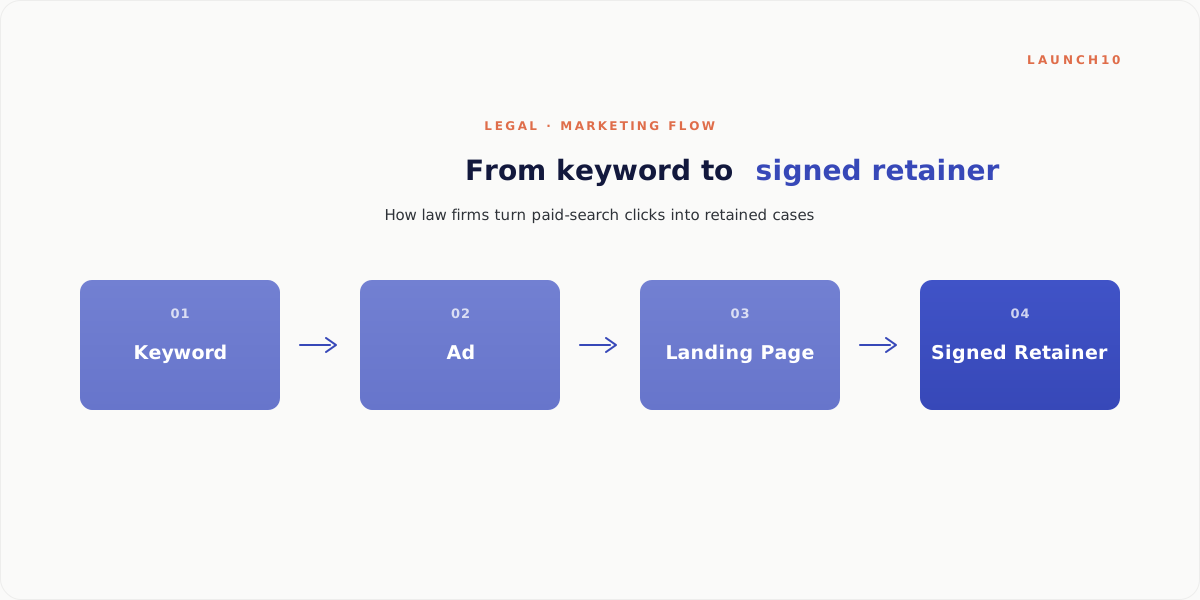
Most law firms running paid ads send traffic to their homepage — and most of those firms have a cost-per-signed-client problem as a direct result. The two are closely related.
A homepage serves every audience — existing clients, job applicants, referring professionals, media, curious visitors. A landing page serves one: the person who just clicked your ad for a specific service. Homepages work for branded searches where the visitor already knows the firm. They don’t work for paid search where the visitor is still deciding who to call.
Service-specific landing pages share a predictable structure:
- Service-matched headline. If the ad said “Divorce lawyer free consultation,” the page says exactly that — not “Welcome to the Smith Law Firm.”
- One call to action, repeated. A phone number above the fold, sticky on mobile, and repeated mid-page and at bottom. Forms are secondary on most legal sites because clients under stress call rather than type.
- Specific trust signals. Bar memberships, years of experience in the specific practice area, recognizable awards, and real photos of the attorneys who will handle the case. Stock photography of generic lawyers kills conversion.
- Practice-area-specific social proof. A family law landing page shows family law testimonials and outcomes. Mixing practice areas on one page dilutes every one.
- Compliance elements. Your state bar’s required disclaimers, office address, and careful claims language. Running without this creates liability that outweighs any marketing gain.
Dedicated landing pages consistently outperform homepages on paid traffic. Unbounce’s 2025 Conversion Benchmark Report puts the legal-services landing-page median conversion rate at about 6.3%, with the middle half of pages falling roughly between 4.4% and 8.6%. Firms that rebuild paid-traffic landing pages around the principles above consistently end up in the upper half of that range, producing meaningfully more consultations from the same ad budget.
We covered this in detail in our landing page and ads integration guide, which applies directly to every legal practice area.
Tracking: Cost per Signed Client, Not Cost per Click
The single highest-leverage change most law firms can make to their marketing is to stop measuring clicks and start measuring signed clients.
Cost per click is easy to report and almost useless as a decision metric. Two campaigns with identical CPCs can produce 5× different cost-per-signed-client numbers because of intake response time, landing page quality, and case-value mix.
The tracking setup that fixes this is not complicated:
- Call tracking numbers on every paid-traffic landing page. Different numbers per campaign and service so you can tell which ad produced each call.
- Form and call conversions firing back to Google Ads. Every qualified lead is a conversion event. Google optimizes toward what you measure.
- Intake status tagging in your CRM. Every lead tagged contacted / consulted / signed / declined / referred-out.
- Monthly reconciliation. Someone at the firm reviews “marketing spend by channel” against “signed cases by source” on the first Monday of every month. Without this reconciliation, every budget decision is a guess.
Firms that install this stack usually discover within 90 days that one or two of their channels are dramatically more efficient than they assumed, and one or two are dramatically less. Reallocation based on real data reliably produces meaningful efficiency gains — better signed-case volume per marketing dollar — which is the point of the tracking in the first place.
For the mechanics, our conversion tracking setup guide walks through each step.
Common Law Firm Marketing Mistakes
The decisions that routinely waste law firm marketing budgets:
- Paying an agency $15K/month with no visibility into the campaigns. If you can’t log into the ad account yourself, you’re overpaying.
- Running ads to the homepage. Reliably wastes a substantial portion of ad budget; legal service landing pages (Unbounce median 6.3% conversion) consistently outperform homepages.
- Targeting “lawyer” instead of “[service] lawyer [city].” Broader keywords cost more and convert less.
- No call tracking. Without it, you can’t tell which marketing works.
- Ignoring GBP. Free traffic with higher intent than almost any paid source.
- Asking for reviews only when the client wins. Systematic review requests after every closed matter build the volume that GBP rewards.
For the Google-Ads-specific tactical playbook — keyword selection, bar-compliant ad copy, and legal landing page essentials — see our companion guide on Google Ads for lawyers.
Launch10 — Built for Solo and Small Firms Who Want Signed Cases, Not an Agency Retainer
We built Launch10 for the solo or small-firm attorney — and the agencies serving them — whose actual job is practicing law, not learning Google Ads. People asked us for case management, intake software, and document automation constantly; we said no. Clio and MyCase already do that work. We built the opposite: a single connected system that handles the landing page and the Google Ads campaign and the conversion tracking and the attribution dashboard.
Here’s what that gets a firm running paid search:
- Real ad cost data baked in, not guessed. Live keyword cost and competition for your jurisdiction — legal CPCs are some of the most expensive in Google Ads; bidding blind is brutal.
- Pages built to win Quality Score. Sub-second LCP, mobile-first, zero bloat — the boring stuff Google rewards with cheaper clicks.
- Practice-area-specific landing pages and Google Ads generated together (PI, family law, criminal defense, employment, immigration), on every plan including Starter, with bar-compliant copy guardrails.
- Click-to-consultation tracking out of the box. Call tracking, GCLID, form submissions, and dollar attribution so you can answer “cost per signed client” by campaign.
- Leads delivered wherever you already work. Clio, MyCase, Filevine, your intake inbox — plus 5,000+ apps via Zapier.
This is not a case-management platform. We run the marketing layer that turns Google Ads spend into signed clients.
Best for: Solo and small firms running paid ads, plus the boutique legal-marketing agencies serving them.
Related reading
- Google Ads for lawyers — the tactical campaign-build companion
- Personal injury lawyer marketing — for firms in that specific practice area
- Connecting landing pages to ads — what most law firm websites get wrong on the ad-to-page handoff
Frequently asked questions
What's the most effective marketing channel for law firms?
How much should a law firm spend on marketing?
Do law firms need a marketing agency?
How do I measure whether law firm marketing is working?

Co-Founder & CEO, Launch10
Greg Hockenbrocht is the Co-Founder and CEO of Launch10. Before Launch10, he was on the executive leadership team at Fundera through its acquisition by NerdWallet, where he led Growth & New Ventures following the company's IPO. Through Illuminated Ventures and work with founders and business owners, he saw a need for Launch10 to help bring clarity, confidence, and ease to digital marketing.