
GoHighLevel Alternative: When a Simpler Tool Beats the All-in-One

GoHighLevel is one of the most successful marketing-platform businesses of the last decade — not because it’s the best at any single feature, but because it bundles every feature an agency might need into a single white-label stack. That bundling strategy works brilliantly for its core audience (marketing agencies reselling services) and works awkwardly for most other users.
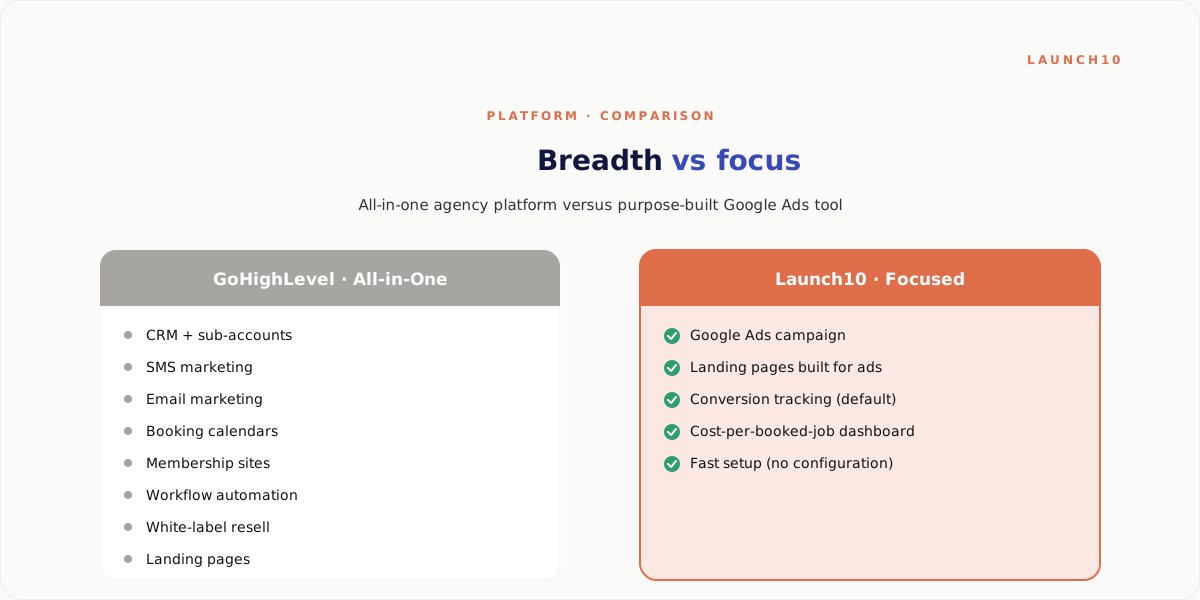
The honest framing is this: all-in-one or all-in-best — pick a side. GHL bundles forty-seven things, each at a 6/10. That’s the right answer for an agency that needs every box ticked because their clients might ask for any of them. It’s the wrong answer for a business owner whose real lever is paid acquisition and who only ever uses four of the boxes. If you’re reading a post titled “GoHighLevel alternative,” you’re probably in that second group: paying for breadth you don’t use, fighting setup complexity you didn’t need, and wondering whether a focused tool would do the 20% of GHL that actually moves your business.
This guide is an honest comparison, not a hatchet job. GoHighLevel is genuinely excellent at what it’s built for. The question is whether what it’s built for is what you need. We’ll walk through who GHL serves well, the specific signals that a focused alternative is the right call, and how Launch10 (purpose-built for the acquisition layer, plugged into whatever CRM and SMS tool you already use) compares for the narrower job most non-agency users actually have.
Who GoHighLevel Is Actually Built For
GoHighLevel is built for marketing agencies that resell services to small business clients, under their own brand, and need a single platform that covers every tool those clients might ask for.
Three design choices reveal the target user. First, the white-label system is first-class: agencies can brand the entire platform as their own, charge clients for logins, and manage unlimited sub-accounts from a central console. That’s not a feature most non-agency businesses need. It’s the feature that drives GoHighLevel’s agency pricing.
Second, the breadth of features is built for the “agency client wants X” problem. If an agency’s client suddenly needs SMS marketing, booking calendars, membership sites, or reputation management, GoHighLevel has all of it without the agency having to add another vendor. Breadth insures the agency against client churn by reducing the number of tools the client could ask for that the agency doesn’t offer.
Third, the pricing tiers scale with agency economics, not business-owner economics. The plans are structured to let agencies resell at margin, with the real value unlocked at the higher tiers that business owners rarely need. A solo business paying for the agency-grade plan often ends up using only a subset of the features they’re paying for.
None of this is a criticism of GoHighLevel. It’s just a fit question. For agencies, the fit is outstanding. For most other users, the fit gets increasingly awkward the further they are from the reseller-of-marketing-services archetype.
Specific Signals an Alternative Is the Right Call
You’re probably in the alternative-seeking group if three or more of these describe your situation:
- You’re not reselling marketing services under your own brand. The white-label system, which is GoHighLevel’s biggest differentiator, becomes overhead instead of value.
- You actively use fewer than half of GHL’s features. You mostly build landing pages and run Google Ads; the CRM, SMS, booking, membership, and workflow automation features sit mostly unused.
- Setup takes longer than you expect. GoHighLevel’s power comes with configuration depth, and many users report spending more time configuring than they did on previous, narrower tools.
- You’re paying an agency-grade monthly fee for a solo or small-business use case. The pricing is rational for agencies; it can feel out of proportion for a single-practitioner business.
- You want Google Ads tracking that works out of the box. GHL can do conversion tracking, but it’s a configuration exercise. Purpose-built Google Ads platforms handle this as a first-class default.
- You need the landing-page workflow to be fast, not configurable. GHL’s page builder is flexible, but flexibility has a cost in time-to-publish. If you need to iterate quickly, a focused tool usually wins.
If fewer than three of these apply, GoHighLevel is probably still the right tool for you — the breadth is serving a purpose. If three or more apply, the cost of that breadth is exceeding its benefit.
How Launch10 Compares for the Narrower Job
Launch10 is purpose-built for the specific workflow most non-agency GoHighLevel users actually run: landing pages that match Google Ads, conversion tracking that works without configuration, and performance monitoring against cost per booked job.
Honest comparison of the two platforms on the features that overlap:
| Feature | GoHighLevel | Launch10 |
|---|---|---|
| Landing page builder | Flexible, broad feature surface, longer setup | Purpose-built for Google Ads, faster time-to-publish |
| Google Ads conversion tracking | Configurable; requires setup work | First-class default; set up on day one |
| CRM | Full-featured, sub-account capable | Not included — pair with focused CRM if needed |
| SMS marketing | Included at most tiers | Not included |
| Email marketing | Included at most tiers | Not included |
| Booking calendars | Included | Not included |
| Membership sites | Included | Not included |
| Workflow automation | Deep, powerful | Limited — scoped to landing-page + ad workflows |
| White-label / agency resell | First-class | Not a primary use case |
| Pricing tier structure | Agency-oriented | Business-owner-oriented |
The trade-off is clear on the surface and clearer in practice. GoHighLevel does more. Launch10 does less, faster, with less setup, and deeper on the one thing it does. For a business whose primary job is “run Google Ads against landing pages that convert,” that depth shows up where it counts: keyword research with real cost data, ad copy with the right extension structure, conversion tracking that ties every click to the dollar amount when they pay you, and a landing page engineered as a signal to Google’s ad-targeting AI — which now reads your page to figure out who to send to it. A bundled all-in-one with five layers of generic templates produces a generic signal. A tool built only for the acquisition layer produces a tuned one. Same dollar of ad spend, very different cost per lead.
For an agency managing twenty client sub-accounts who all need different tool combinations, GoHighLevel’s breadth is the feature. For an owner running their own campaigns, depth on the acquisition layer plus integrations to whatever CRM, SMS tool, and calendar they already use almost always fits better.
Migration Considerations If You’re Leaving GoHighLevel
Migrating off GoHighLevel is straightforward for the landing-page and ad-tracking parts of the system. It’s harder if you’ve built significant automation workflows or a CRM with historical contact data.
A practical migration sequence:
- Audit what you actually use. List every feature of GHL your team has touched in the last 90 days. If the list is mostly landing pages and Google Ads tracking, migration is clean. If the list includes automation, CRM, and email flows, plan for a multi-tool replacement.
- Export your data first. GoHighLevel allows exporting contacts, form submissions, and page content. Do this before you cancel.
- Rebuild landing pages in the new tool. Don’t try to port HTML exactly — rebuild with the new tool’s native components. It’s faster and the pages perform better.
- Set up conversion tracking in the new tool fresh. Don’t try to migrate tracking pixels; re-create the conversion events cleanly.
- Run both systems in parallel for 2 weeks. Keep GHL active while the new setup runs, verify conversion data matches across both, then cancel.
- If you used GHL for CRM, migrate contacts to a focused CRM. HubSpot Starter Customer Platform, Close, and Pipedrive all handle CSV import cleanly.
Simpler migrations (landing pages and Google Ads only) are substantially faster than full migrations involving automation, CRM pipelines, and integrations. Plan scope and timeline based on which GHL subsystems you actually depend on.
How to Decide
Choose GoHighLevel if you’re an agency reselling marketing services, you use more than half of its features actively, or you genuinely need the all-in-one scope. The platform is excellent for those use cases and has no real peer in the agency-white-label category.
Choose Launch10 or a similarly focused tool if your real job is running Google Ads against converting landing pages, you don’t need CRM / SMS / booking bundled in, and you’d rather have one tool that’s fast at the specific workflow than one tool that does twenty workflows adequately.
For business owners who don’t need the breadth, the simpler tool almost always ships ads faster, iterates pages quicker, and produces cleaner tracking — because it was built for that narrow job specifically.
If you want a broader sense of the landing-page and Google Ads tooling landscape, our comparisons with Unbounce and Leadpages cover the focused-builder category in more depth.
How Launch10 Fits Into a Post-GoHighLevel Stack
Launch10 replaces the acquisition layer of GoHighLevel and connects to whatever you keep for the rest. That’s it. That’s the whole shape.
Concretely: we run keyword research, build the landing page, generate the Google Ads campaign with proper extension structure, and track every click through to the form fill, the lead, and the dollar amount when they pay you. Every week you get a short list of decisions in plain English — “Cut this keyword. Test this headline. Add these zip codes” — instead of dashboards you have to interpret on a Sunday night.
Then we hand off. Leads land in HubSpot, Salesforce, Mailchimp, Slack, your own webhook — 5,000+ tools via Zapier. Your CRM stays your CRM. Your SMS provider stays your SMS provider. Your appointment booker stays your appointment booker. We’re not asking you to rip and replace the four tools you actually use. We’re asking you to stop renting the forty-three you don’t.
For a business leaving GoHighLevel because the breadth was serving the wrong use case, the math usually works the same way every time: setup time drops, the bill drops, and the campaigns get sharper because the tool is built for the campaign instead of around it.
Related reading
- GoHighLevel alternatives — companion roundup with the full alternatives list
- Why your Google Ads aren’t generating leads — foundational diagnostic for paid-search-focused operators
- Connecting your landing page and ads — the integrated-build concept GHL approximates with bundled tools
Frequently asked questions
Who is GoHighLevel actually built for?
Is GoHighLevel worth it for a non-agency business?
What's the easiest GoHighLevel alternative to migrate to?
Can I replicate GoHighLevel's features with cheaper tools?

Co-Founder & CEO, Launch10
Greg Hockenbrocht is the Co-Founder and CEO of Launch10. Before Launch10, he was on the executive leadership team at Fundera through its acquisition by NerdWallet, where he led Growth & New Ventures following the company's IPO. Through Illuminated Ventures and work with founders and business owners, he saw a need for Launch10 to help bring clarity, confidence, and ease to digital marketing.