
Chiropractor Marketing: Get More Patients Without Relying on Referrals

Chiropractic marketing in 2026 has a quiet advantage most practices aren’t using: the competitive landscape online is thinner than in most healthcare categories. The top results for most chiropractor searches are a mix of small practices, community pages, and generic directory listings — not high-authority industry media. That means a practice with decent content, an optimized Google Business Profile, and a properly-run Google Ads account can leapfrog more expensive competitors within a few months.
This guide covers how to build that system: which channels produce booked appointments (and which waste money), what a converting chiropractic landing page actually looks like, and the specific tracking setup that tells you whether your marketing is working this week — not six months from now.
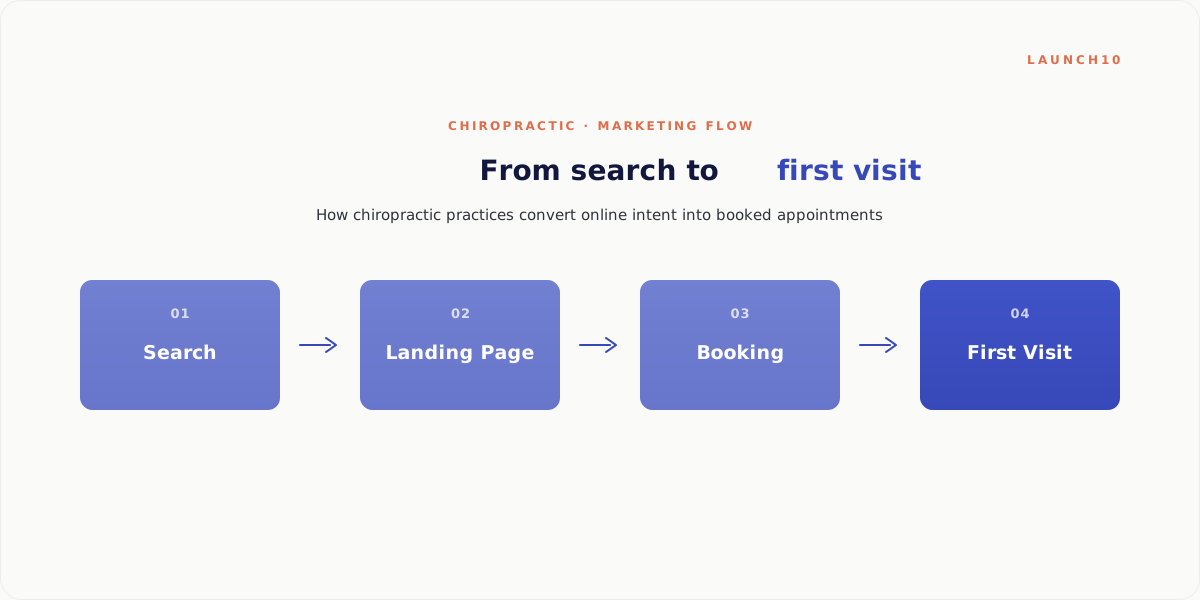
Why Chiropractic Marketing Is Different from Other Healthcare
Chiropractic sits between healthcare and wellness — higher trust requirements than a day spa, but less insurance-driven than most medical specialties, which changes every channel decision.
Three dynamics shape chiropractic marketing. First, the buyer journey is often pain-driven. A significant share of new patients come in with acute back pain, sciatica, neck pain, or post-accident injuries. These patients aren’t shopping on price — they’re looking for fast relief, and they’re choosing whoever can see them this week. Marketing that emphasizes immediate availability, specific pain specialties, and fast-scheduling outperforms marketing that leads with philosophy or credentials.
Second, insurance coverage is inconsistent and varies by state and plan. Some patients have chiropractic coverage and filter by in-network. Others pay out of pocket and filter by price transparency. A practice that clearly communicates both — which insurance it accepts and typical out-of-pocket costs — converts better than a practice that hides the question behind “call for pricing.”
Third, the category has a trust-credibility spread. A well-established chiropractic practice with specific sub-specialties (sports injury, pediatric, post-accident rehabilitation) can position itself distinctly. A general “we fix backs” practice competes on generic terms where trust cues matter most: reviews, team photos, clinical explanations, and specific outcomes.
The Channels That Actually Produce New Patients
For most chiropractic practices, the bulk of measurable new patients come from a small number of channels. In rough order of payoff for small-to-mid practices:
- Google Business Profile (GBP). The single highest-leverage free asset. A GBP with regular posts, specific service categories, team photos, substantial reviews, and owner responses to every review captures the majority of “chiropractor near me” traffic.
- Google Ads on service and condition keywords. Not “chiropractor” — “sciatica treatment [city],” “back pain specialist [city],” “sports chiropractor [city],” “auto accident chiropractor [city].” Specific-intent keywords consistently outperform generic category terms on cost, conversion, and relevance — the small-business guide to Google Ads covers how to build the account.
- Website and landing pages built for conversion. Not a digital brochure — a set of service-matched pages that each do one job: turn a visitor into a booked appointment.
- Review generation. Automated review workflows materially increase review volume; Birdeye reports that Complete Care grew reviews per location by 3,653% after automating review requests. BrightLocal’s 2026 Local Consumer Review Survey finds 97% of consumers read reviews for local businesses, so review volume compounds directly with local search visibility.
Below the top four: Instagram and TikTok can work for practices focused on before/after content, manipulation technique videos, or athlete partnerships — but they’re a supplement, not a pipeline. Facebook ads produce intermittently and require careful creative. Direct mail occasionally works for new-to-area campaigns.
Paid vs. Organic: How Chiropractic Marketing Dollars Should Flow
For most chiropractic practices, paid channels fill the appointment book this month and organic channels (GBP, SEO) build the practice value over years. Both matter; the sequencing matters as much as the mix.
| Channel | Time to first patient | Best fit |
|---|---|---|
| Google Ads (service + condition) | 2–6 weeks | Filling openings, launching specialties, competitive markets |
| Google Business Profile | 2–4 months | Every practice — run always, compounds over time |
| SEO (service + location pages) | 6–12 months | Practices expecting to operate 5+ years in the same location |
| Facebook/Instagram | 2–6 weeks | Retargeting, cosmetic positioning, athlete/local partnerships |
| Direct mail | 1–3 months | New practice launches, welcome-to-area campaigns |
Cost per new patient varies heavily by market, service mix, and intake efficiency; track your own numbers rather than relying on universal benchmarks.
The pattern: practices that run Google Ads before optimizing GBP pay more per new patient than they need to. GBP optimization improves ad Quality Score, reduces cost per click, and captures organic traffic that would otherwise require paid spend to reach. Order of operations matters.
What a Converting Chiropractic Landing Page Needs
A chiropractic landing page converts when it answers one question in 20 seconds: “Can this practice help my specific problem, this week, at a price I can understand?”
Every element on the page should serve that answer. Most chiropractic websites fail because they try to serve every audience — new patients, existing patients, insurance inquiries, continuing education — on every page.
Landing pages that produce bookings share a predictable structure:
- Condition-matched headline. If the ad was “Back Pain Specialist in [City],” the page says exactly that. Not “Welcome to Wellness Chiropractic.” Generic headlines force visitors to decide whether they’re in the right place, and half will leave before they do.
- Booking CTA above the fold. Online scheduling widget, phone number, or both — visible without scrolling. Chiropractic visitors are often in pain and don’t want to read three paragraphs before finding how to book.
- Insurance and pricing transparency. “We accept [specific plans]” or “New patient visit $X, subsequent visits $Y.” This single element moves conversion more than any amount of copy polish.
- Real photos of the practice and team. Stock photography of generic chiropractors reads as low-trust. Patients want to see the actual adjustment room, the actual table, the actual doctor.
- Specific clinical approach or specialty. “We specialize in auto-accident injury rehabilitation” or “Our practice focuses on sports injury recovery” outperforms vague “We help with pain.”
- Reviews pulled automatically. Not static testimonial quotes — an embedded Google reviews feed or a well-placed review excerpt with the reviewer’s real first name.
- Stripped navigation. No About page link, no blog sidebar, no social icons. Every click that isn’t “book appointment” or “call” is an exit.
Dedicated landing pages consistently outperform generic site pages on paid traffic. Unbounce’s 2024 Conversion Benchmark Report puts the median landing-page conversion rate across industries around 6.6%, with meaningful variance by industry. Practices that rebuild paid-traffic landing pages around the principles above consistently see meaningful booking-rate lift from the same ad spend.
The same thesis applies here as in our landing page and ads integration guide.
Tracking That Tells You What’s Actually Working
Most chiropractic practices measure activity — website traffic, Facebook likes, ad impressions — instead of outcomes. Fix the tracking first, or every other decision is a guess.
At minimum, every practice running paid marketing should be able to answer three questions by Friday of any week:
- Cost per new patient, by channel. Not cost per click, not cost per form fill — cost per patient who actually came in for a first visit.
- Retention by patient source. Patients from Google Ads, GBP, referrals, and social often have different retention patterns. Track them separately.
- Payback period. How many visits until marketing acquisition cost is recouped.
The tracking stack for this isn’t complex but requires intention to set up: call tracking numbers per paid channel, form conversions firing back to Google Ads, and a source-of-patient field in the practice management system that the front desk captures at check-in. Practices that install this stack consistently find one or two of their channels are doing most of the real work, and one or two are consuming budget without producing patients.
Without the tracking in place, every budget decision about marketing is a faith-based argument. With it, the first Monday of every month produces a reallocation decision grounded in data.
For the specific setup mechanics, our AI Google Ads tools guide covers the tracking setup in detail.
Common Chiropractic Marketing Mistakes
The decisions that routinely cost chiropractic practices the most:
- Running Google Ads to the homepage. Almost always wastes a substantial portion of ad budget; dedicated landing pages reliably outperform.
- Targeting “chiropractor” as a primary keyword. Too broad, too expensive, too low-intent compared to condition-specific keywords.
- Ignoring GBP. Free, high-intent traffic going to the practice with the better-maintained profile.
- No call tracking. Reallocation decisions become guesses.
- Only asking for reviews when a patient is thrilled. Systematic review requests after every visit produce substantially more volume.
- Discounting new patient visits aggressively. $29 first visits attract price-sensitive patients with low retention. Positioning and trust beat discount pricing in almost every long-term comparison.
- Spending on social before search is saturated. Chiropractic intent lives in search. Social is a multiplier on search, not a substitute.
Launch10 — Built for Chiropractors Who Want a Full Schedule, Not a Marketing Project
We built Launch10 for the chiropractic practice owner — and the agencies serving them — whose actual job is treating patients, not learning Google Ads. People asked us for patient portals and EHR integration constantly; we said no. ChiroTouch and Jane App already do that work. We built the opposite: a single connected system that handles the landing page and the Google Ads campaign and the conversion tracking and the attribution dashboard.
Here’s what that means for a practice running paid search:
- Real ad cost data baked in, not guessed. Live keyword cost and competition for your zip code — no bidding blind on “chiropractor near me.”
- Pages built to win Quality Score. Sub-second LCP, mobile-first, zero bloat — the boring stuff Google rewards with cheaper clicks.
- Condition-specific landing pages and Google Ads generated together (sciatica, low back pain, auto accident, sports injury), on every plan including Starter.
- Click-to-call tracking out of the box. Call tracking, GCLID, conversion events, and dollar attribution so you can answer “cost per booked first visit” by campaign.
- Leads delivered wherever you already work. Jane App, Genbook, your front desk inbox — plus 5,000+ apps via Zapier.
This is not a practice-management platform. We run the marketing layer that fills the schedule.
Best for: Chiropractic practices running $1.5K–$8K/month in paid ads, plus the agencies and in-house marketers serving them.
Related reading
- Why your Google Ads aren’t generating leads — diagnose campaigns before blaming the page
- Connecting landing pages to ads — what most practice sites get wrong on the ad-to-page handoff
- Launch10 pricing guide — what’s included on each tier
Frequently asked questions
What's the best marketing channel for chiropractors?
How much should a chiropractor spend on marketing?
What's a good cost per new patient for chiropractors?
Do chiropractors need a website for marketing?

Co-Founder & CEO, Launch10
Greg Hockenbrocht is the Co-Founder and CEO of Launch10. Before Launch10, he was on the executive leadership team at Fundera through its acquisition by NerdWallet, where he led Growth & New Ventures following the company's IPO. Through Illuminated Ventures and work with founders and business owners, he saw a need for Launch10 to help bring clarity, confidence, and ease to digital marketing.