
Your Website Says You Offer It. AI Says You Don't.
A field study of Meta's Muse: why it tells customers a business doesn't offer a service it does, and the one change that reversed it.
The twenty-second version
In November 2026, we asked Meta’s AI assistant, Muse, simple questions about local businesses: “Does [business] in [city] do [service]?” We cleared Muse’s memory before each question and checked its answers against the businesses’ own websites. For our own site, we also checked our server logs to see exactly which pages Muse read.
- Muse told customers “no” about services the business does offer. It happened to 3 of the 16 Michigan painting companies we asked about. In one case it then offered to find a competitor.
- It happened to us, too. Muse said eight times, over eight days, that Launch10 has no page for roofing companies. We do.
- One plain-text FAQ answer on our homepage changed the answer to “yes” within minutes. Getting the page into Google, linking it from the footer, and adding a homepage link line had not.
- When we removed the FAQ answer, Muse went straight back to “no.” The fix only works while it stays on the page.
The pattern behind all of it: Muse reads one page of your site, usually the homepage, and keeps only the plain text. If the service isn’t named there, Muse doesn’t say “I’m not sure.” It says no.
Why we ran this
Meta’s Muse is one of a new wave of personal AI assistants that answer questions about local businesses on a customer’s behalf. It’s growing fast: Meta said in October 2026 that Muse had more than 10 million users, about six weeks after launch. A customer who asks “does this painter do epoxy floors?” gets one answer, not ten blue links. If that answer is wrong, the customer never sees the website that would have corrected it.
We wanted to know two things:
- When Muse says a business does or doesn’t offer something, where does that answer come from?
- Is there anything a business owner can change on their own site to fix a wrong answer?
Part 1: Muse told a customer we don’t serve roofers
Launch10 has a dedicated page for roofing companies at launch10.com/roofing. It has been live since April 2026.
Starting on November 2, we asked Muse, “Does Launch10 have anything for roofing companies?” The answer was some version of the same thing every time:
“No roofing-specific page on launch10.com (a site search turns up nothing).”
Over the next eight days we tried every fix a reasonable website owner would try, and asked again after each one:
| What we changed | Did Muse’s answer change? |
|---|---|
Got /roofing indexed in Bing, then Google (top 3 results for a roofing search on our domain) | No |
Listed /roofing in our sitemap and llms.txt file (already true since July) | No |
| Added a “Roofing” link to the homepage footer | No |
| Added a homepage line: “Run a roofing company? See Launch10 for roofers →“ | No |
| Cleared Muse’s memory and asked from scratch | No |
| Waited a week | No |
Our server logs (Cloudflare) showed why. Each time, Muse’s fetcher (meta-webindexer) requested our homepage and nothing else. It read the page live, then told us the homepage “doesn’t mention roofing.” At that moment the homepage mentioned roofing four times.
What Muse kept, and what it threw away
We compared what Muse quoted with where each piece of text sits on the page:
| Homepage text | Where it sits | Did Muse use it? |
|---|---|---|
| Customer showcase paragraph | Plain prose | Quoted |
| ”Tell us what you sell…” intro | Plain prose | Quoted |
| Pricing FAQ | FAQ section | Quoted |
| ”Tampa roofer — storm damage jobs” | A button | Ignored |
| ”HVAC, plumbing, dental, roofing, contracting” | Inside a clickable card | Ignored |
| ”Run a roofing company? See Launch10 for roofers →“ | A section that’s mostly links | Ignored |
| ”Roofing” | Footer | Ignored |
That pattern looks like “reader mode”: keep the article-like text, drop the menus, buttons, link lists and footer as page clutter. That’s our inference from what Muse used and ignored. Meta hasn’t documented how Muse reads pages.
Part 2: one FAQ answer flipped it
If Muse keeps FAQ text, a roofing answer in the FAQ should get through. On November 10 we added one entry to our homepage FAQ:
Does Launch10 serve roofing companies? Yes. Roofing is one of the home-service trades we build for: landing pages, Google Ads, and tracking for roofers, without an agency retainer. See launch10.com/roofing.
The URL was written out as plain text, not as a link. Minutes after it went live, we cleared Muse’s memory and asked the same question:
“Yes, they have a dedicated page for it: Launch10 for Roofers.”
Muse quoted the FAQ answer word for word, then accurately summarized the roofing page itself. When we asked where the answer came from, it said: “Straight from Launch10’s own site — I read both pages just now.”
The server logs show the chain directly:
| Time (EST) | Request from meta-webindexer |
|---|---|
| 10:29:22 | GET / (homepage) |
| 10:29:25 | GET /roofing, 3 seconds later |
It was the first time in the whole experiment that Muse had opened /roofing without our naming the page. We repeated the test and got the same result: “yes,” and homepage → /roofing three seconds apart in the logs (10:36:55 → 10:36:58).
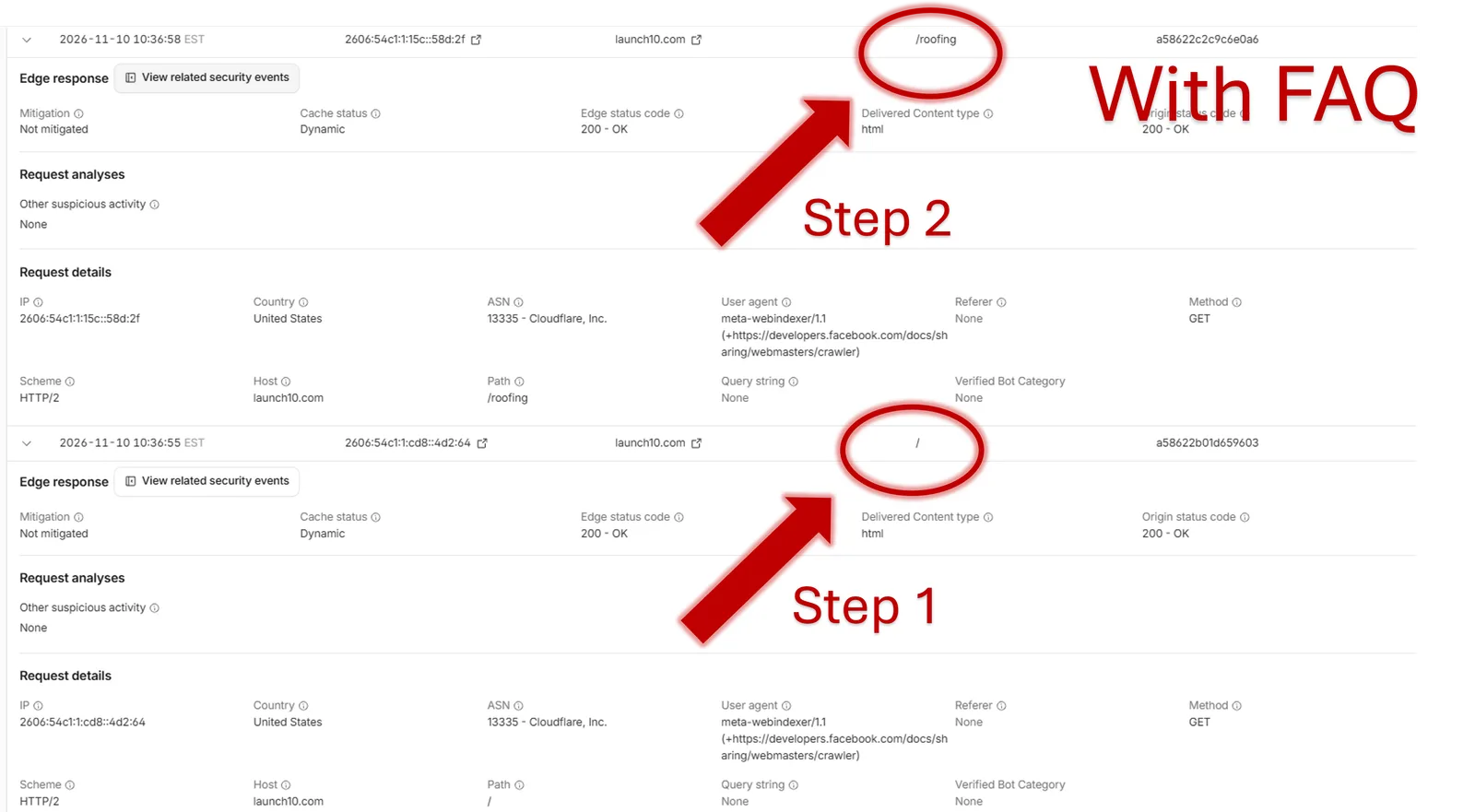
With the FAQ answer live: Muse’s fetcher (meta-webindexer/1.1) reads the homepage (step 1), then follows the written-out URL to /roofing three seconds later (step 2).
Part 3: we took it away, and the “no” came back
A “yes” after a change could still be coincidence. Maybe Meta’s systems had finally caught up with the page, and the FAQ timing was luck. So we removed the FAQ entry and changed nothing else. Every roofing mention that existed during the eight “no” answers was still on the site.
With memory cleared again, Muse went straight back to:
“There’s no dedicated roofing page on launch10.com.”
The logs showed a homepage request and no /roofing request.
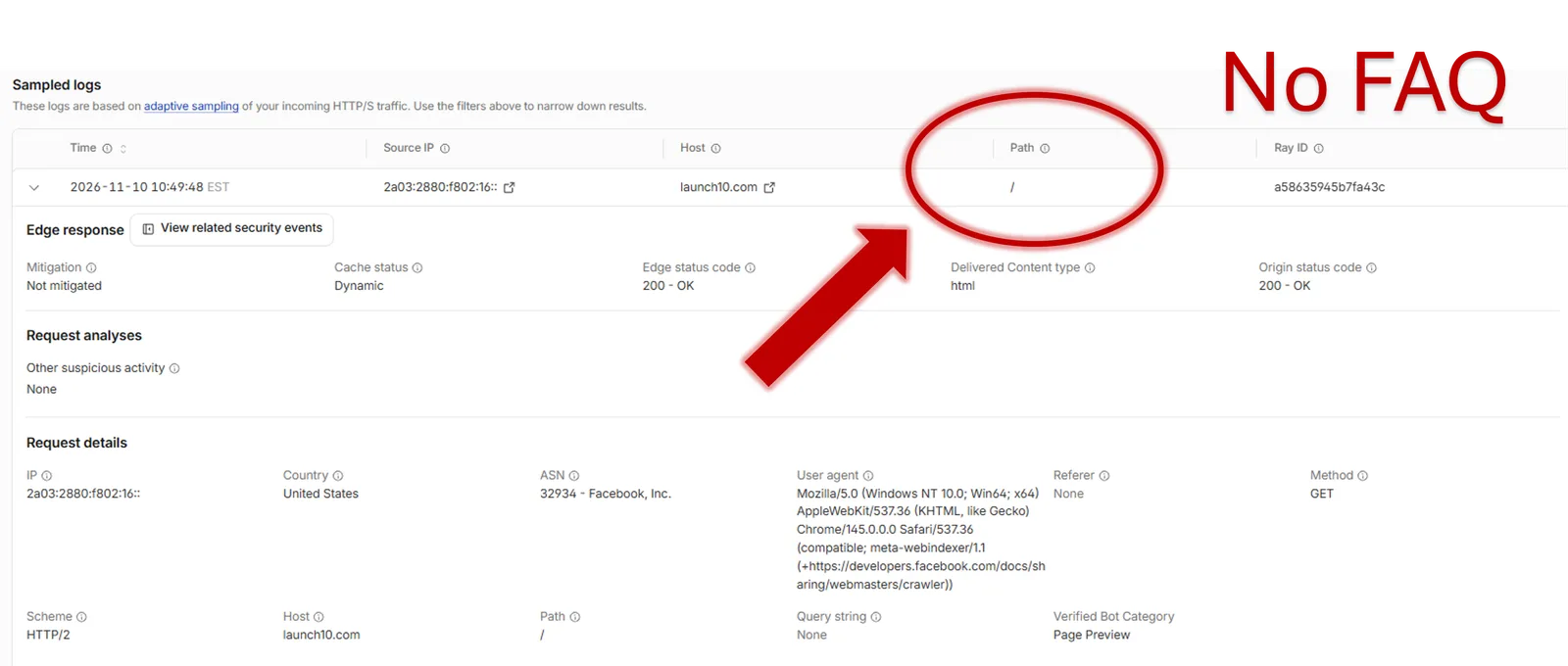
After the FAQ answer came down, Meta’s requests stopped at the homepage. This entry is Meta’s link-preview request (10:49:48). The assistant’s own read, a minute earlier at 10:48:42, was also the homepage only.
| Phase | Homepage FAQ about roofing | Muse’s answer |
|---|---|---|
| Before (Nov 2–10) | None | ”No,” 8 times |
| FAQ added | Present | ”Yes,” 2 of 2, roofing page read |
| FAQ removed | None | ”No” |
Two conclusions follow:
- The FAQ answer caused the change. Nothing else differed between the “yes” and the second “no.”
- Muse didn’t remember the page it had just read. Two live reads of
/roofingdidn’t put it into whatever Muse searches. The fix only works while it’s on the homepage.
Part 4: it happens to real local businesses
One site is an anecdote. So we asked Muse about painting companies in Michigan: 16 businesses and 18 questions across three rounds. Each question named a service the company lists somewhere on its own website. We cleared Muse’s memory before every question, then asked where its answer came from.
What happened:
| Result | Questions |
|---|---|
| ”Yes,” confirmed from the business’s own site | 9 |
| ”Yes,” but only because a directory listing (Angi, HomeGuide, Yellow Pages, MapQuest and others) said so | 6 |
| ”No,” for a service the business offers | 3 |
The three false “no” answers:
- A Dearborn painting company, epoxy floor coating. Muse said the company “lists only three services,” then asked: “Want me to find epoxy floor specialists in Dearborn instead?” Epoxy floors are listed on the company’s services page, linked from its main menu.
- An Ann Arbor painting company, wallpaper removal. Muse: “Not as a listed service, as far as I can verify.” Wallpaper removal is listed on the company’s services page, also linked from its main menu.
- A Troy painting company, popcorn ceiling removal. Muse “couldn’t find any indication that they advertise it.” The service is on the company’s interior painting page.
In each case the service was on the website, just not on the homepage, and Muse never opened the page where it was.
The directory rescues are a risk of their own. In 6 of 18 questions, the “yes” came from a directory profile, not from the business. One example: Muse confirmed a Muskegon company does exterior painting, but noted that “the homepage text I could read didn’t spell out ‘exterior’ itself. That part came from the two listings above.” Those answers are right only as long as a listing the business doesn’t control stays accurate.
What predicted the answer
The pattern matched what we saw on our own site:
| Where the service appears | What Muse did |
|---|---|
| Named in the homepage’s plain text or FAQ | Confirmed it from the site |
| Has its own page, named in the page title | Usually found it (directly or through Muse’s search) |
| One bullet on a general “Services” page | Didn’t open the page; said no, unless a directory filled in |
| Only in menus, buttons, link cards or the footer | Ignored |
One company’s homepage FAQ (“What types of services do you offer? … drywall repair…”) was quoted word for word. That’s the same mechanism that fixed our roofing answer, working on a site we had nothing to do with.
We tested whether the pattern predicts Muse’s answers
We turned these rules into a simple checker. It reads a site the way Muse appears to, keeps only the plain text, and predicts whether Muse will confirm each service. We built the rules from the first 12 cases, so matching those proves little. The real test was the next 8 questions, on businesses the checker hadn’t seen: we wrote the predictions down before asking Muse.
The checker predicted Muse’s answer correctly in 8 of 8, including the Troy company’s false “no.”
What to do about it
If you want AI assistants to confirm what you offer, put it where they read:
- Add a homepage FAQ entry for each service you want found. Use a question a customer would ask, like “Do you do popcorn ceiling removal?”, and answer it in plain sentences.
- Write the page address out in the answer, like “See yoursite.com/interior-painting.” A written-out URL is what led Muse from our homepage to
/roofing. - Make it real page text. If the FAQ lives in a pop-up, an accordion that loads later, or an image, a reader that only keeps text may never see it.
- Leave it there. Our reversal showed the fix stops working the moment it comes down. A site redesign or a theme update that drops the FAQ brings back the “no.”
- Then ask the assistant yourself. Clear its memory first (Muse remembers past chats), then ask: “Does [your business] in [your city] do [service]?” Follow up with “Where did you get that?” The second answer shows whether it read your site or a directory.
And check your directory profiles. In a third of our questions, a listing was the only reason Muse got it right.
Limits
This is a field study, not a census. Read it with these limits in mind:
- One assistant. We tested Meta’s Muse only. ChatGPT, Gemini and others may read pages differently. Muse itself will change.
- One industry, small samples. 16 Michigan painting companies and one software company. The false-”no” rate (3 of 18 questions) is directional, not a market-wide estimate.
- Server logs only for our own site. For the painters, we know what Muse said and which sources it named, not which pages it requested.
- Some early roofing runs weren’t clean. Muse remembers across chats, and a few of the eight “no” answers came before we cleared that memory. The decisive runs (the cleared-memory “no,” both “yes” runs, and the reversal) were all memory-cleared.
- What we didn’t test. We didn’t test structured data (JSON-LD) on its own. Our HVAC and plumbing studies looked at structured data as a signal for AI search engines. This study looked at a different question: what an assistant reads when it visits your page. The answer here was visible, plain text.
Methodology, briefly
- Dates: November 2–10, 2026.
- Question format: “Does [business] in [city], MI do [service]?”, then “Where did you get that?” Muse’s memory was cleared before each question.
- Business selection: independent residential painting companies in Michigan with their own websites, in three rounds. Round 1 came from our earlier 20-site sample. Round 2 picked companies with thin review profiles (fewer than 15 Google reviews). Round 3 was new businesses the checker hadn’t seen. Each tested service was verified on the business’s own site before asking.
- Our own site: every Muse request was identified in Cloudflare by its user agent (
meta-webindexer/1.1), with timestamps matched to Muse’s stated read times. - Quotes: all Muse quotes are word for word from the transcripts. Painting companies are described by city, not named.
Want us to check your site?
We’ll run the same check on your homepage: which of your services an AI assistant can confirm, which ones it’s likely to say “no” to, and the exact FAQ text that fixes each gap.

Co-Founder & CEO, Launch10
Greg Hockenbrocht is the Co-Founder and CEO of Launch10. Before Launch10, he was on the executive leadership team at Fundera through its acquisition by NerdWallet, where he led Growth & New Ventures following the company's IPO. Through Illuminated Ventures and work with founders and business owners, he saw a need for Launch10 to help bring clarity, confidence, and ease to digital marketing.