
Roofing Marketing: Lead Gen That Doesn't Waste Your Ad Spend

Roofing marketing has a spending-efficiency problem more than a channel problem. Most roofing businesses have access to the same channels — Google Ads, Local Services Ads, Google Business Profile, Facebook, lead aggregators — and yet cost per signed job varies 4× or more between competitors in the same market. The difference isn’t budget size. It’s whether the operation tracks what’s working and ruthlessly reallocates away from what isn’t.
This guide covers the channels that actually produce qualified roofing leads, the landing pages and intake setup that convert them, and the tracking stack that tells you what to scale versus what to cut. It’s written for owners who’d rather spend $3K and close ten jobs than spend $10K and close twelve.
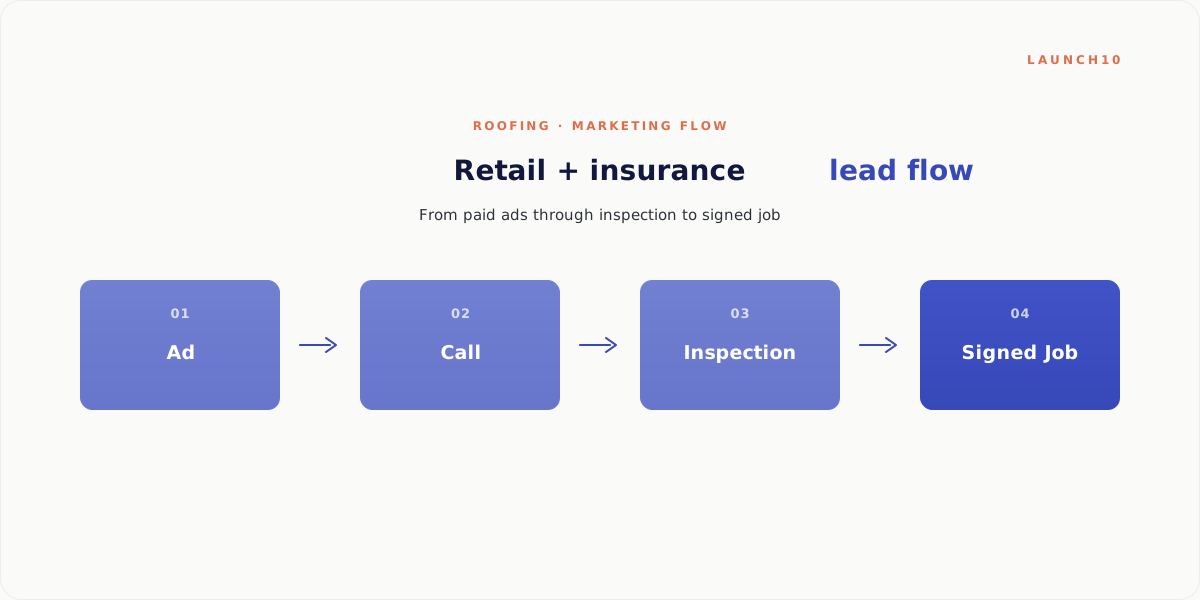
What Makes Roofing Marketing Different from Other Home Services
Roofing has shorter decision windows, higher ticket sizes, and larger insurance-driven demand than most service categories — which means the marketing playbook from HVAC or plumbing doesn’t fully transfer.
Three dynamics shape roofing decisions. First, residential reroof work is generally a high-ticket purchase, which supports cost-per-lead budgets that would be reckless in lower-ticket trades. A roofer can rationally pay substantially more per lead than a drain-cleaning business can, because the contribution margin on a single signed job is materially larger. Calculate your own acceptable lead cost from your average job value, gross margin, and close rate.
Second, insurance work and retail work have completely different customer behaviors. Insurance-driven leads (hail damage, storm damage) search for “roof damage insurance claim” or “storm damage inspection” with one eye on their adjuster. Retail leads (old roof, leak, planned replacement) search for “roof replacement cost” and compare three bids. Marketing that blends these audiences dilutes both.
Third, trust cues matter more than in most home trades because the cost of a bad outcome is high. A botched drain clean is annoying. A botched roof is catastrophic — leaks, structural damage, insurance fights. Customers over-index on reviews, BBB ratings, licensing, insurance, and “how long have you been in business.” Marketing that doesn’t lead with trust signals loses.
The Channels That Drive Qualified Roofing Leads
Most roofers will get 80%+ of their qualified leads from five channels. In rough order of payoff for small-to-mid operations:
- Google Business Profile (GBP). The single most underused free asset in roofing marketing. A complete GBP with weekly posts, job-site photos, 150+ reviews, and real owner responses captures “roofer near me” searches that would otherwise go to competitors with better profiles.
- Google Local Services Ads (LSAs). Pay-per-lead, top of search results, and the Google Verified badge signals trust. For most roofers, LSAs should be running at their daily lead cap before any other paid channel scales up.
- Google Ads on service-specific keywords. “Roof replacement [city],” “storm damage inspection [city],” “flat roof repair [city]” — specific keywords with dedicated landing pages outperform generic “roofer” terms by every metric — the fundamentals of running Google Ads cover how to build those campaigns from scratch.
- Door-knocking and canvassing after storms. Still produces the lowest cost per signed job in most markets when executed disciplined. Pairs well with paid ads targeting the same ZIP codes after storm events.
- Review generation. Automated review workflows materially increase review volume; Birdeye reports that Complete Care grew reviews per location by 3,653% after automating review requests. BrightLocal’s 2026 Local Consumer Review Survey finds 97% of consumers read reviews for local businesses — volume compounds GBP, LSAs, and Google Ads Quality Score simultaneously.
Below the top five: Facebook and Instagram ads can produce, especially for retargeting. Direct mail remains viable in storm-chase operations. Lead aggregators (HomeAdvisor, Angi, Networx) typically underperform their promises but fill capacity gaps.
Paid vs. Organic: How Roofing Dollars Should Actually Flow
In roofing, paid channels fill the pipeline this week. Organic channels (GBP, SEO) build the pipeline that doesn’t require weekly ad spend to keep flowing. Both matter, and sequencing them correctly saves money.
| Channel | Time to first qualified lead | Best for |
|---|---|---|
| Google Local Services Ads | 2–4 weeks | Every roofer — run first, maxed |
| Google Ads (service + location) | 2–6 weeks | Fills demand LSAs can’t absorb |
| Google Business Profile | 1–3 months | Compounds over time, free to run |
| SEO (service + location pages) | 6–12 months | Multi-year operations in the same market |
| Facebook/Instagram | 1–4 weeks | Retargeting, cosmetic upgrades, storm events |
| Lead aggregators | Immediate | Capacity filler, not pipeline backbone |
Cost per qualified lead varies by market. For broader category context, WordStream’s 2025 benchmark data for Home & Home Improvement averages $90.92 CPL in paid search. Track your own CPL against signed-job outcomes to decide which channels to scale.
The most common strategic error: running Google Ads aggressively before maxing LSAs and before fixing GBP. This reliably produces higher cost-per-lead numbers than necessary, because Google’s Quality Score rewards businesses that also show organic relevance, and LSA leads usually outperform Google Ads leads on lead quality in roofing specifically.
The Landing Page Problem (and What Converts Instead)
Most roofing websites are online brochures. Landing pages are conversion machines. The difference is worth 3–5× in booking rate on the same ad spend.
A roofing landing page that actually produces calls shares a predictable structure:
- Service-matched headline. If the ad said “Free storm damage inspection — [City] roofers,” the landing page headline says exactly that. Generic “Quality roofing since 1994” headlines burn ad budget by forcing visitors to decipher whether they’re in the right place.
- Phone number visible everywhere. Top, mid-page, bottom, sticky on mobile. Roofing customers call more than they fill forms. Make calling easier than leaving.
- Trust stack above the fold. Google Verified (if LSA-enabled), BBB rating, years in business, licensing/insurance language, and at least one recent review with a photo.
- Job photos from recent projects. Real homes in your actual service area, not stock photography. Before-and-after photos convert especially well for retail work.
- Specific financing or insurance language. “We work with [insurance carriers]” or “Financing available with approved credit, 0% for 12 months” handles the two objections roofing customers have most often.
- A single primary call to action. Call for a free inspection, or request an inspection online. Pick one as the dominant path.
- Stripped navigation. Landing pages aren’t homepages. Every menu item is an exit.
Dedicated landing pages consistently outperform homepages on paid traffic. Unbounce’s 2025 Conversion Benchmark Report puts the median landing-page conversion rate across industries around 6.6%. Roofers that rebuild paid-traffic landing pages around the principles above consistently see meaningful lift in qualified consultations from the same ad spend — usually the single biggest ROI lever in the marketing system.
This pattern is covered in more depth in our landing page and ads integration guide.
Tracking: Cost per Signed Job, Not Cost per Lead
Most roofers track cost per lead. The number that matters is cost per signed job. Two businesses with identical cost-per-lead numbers can have 3× different cost-per-signed-job numbers because of intake speed, sales close rates, and lead quality mix.
The tracking stack for a typical roofing operation:
- Call tracking numbers per channel. LSAs, Google Ads, Facebook, direct mail — each gets its own number so inbound calls are attributable.
- Lead source captured at intake. The person answering the phone asks or observes where the lead came from and logs it in your CRM.
- Close status tracked through the pipeline. Every lead tagged inspected / quoted / signed / lost / referred. Close rates become visible per channel and per salesperson.
- Monthly reconciliation. Marketing spend by channel versus signed-job revenue by source, reviewed on a predictable cadence.
Roofing operations that install this stack consistently find that one or two of their channels are doing dramatically more work than they assumed, and one or two are consuming budget without producing signed jobs. Reallocating on that data is where the real ROI gains show up — not in finding new channels.
If tracking has never been properly set up, start with our Google Ads conversion tracking guide and why Google Ads sometimes fail to generate leads. Both cover the mechanics in detail.
Common Roofing Marketing Mistakes
The decisions that routinely cost roofing businesses the most:
- Running Google Ads before LSAs are maxed. Almost always overpays per lead.
- Neglecting GBP. Free, high-intent traffic going to competitors with better profiles.
- Sending all traffic to the homepage. Wastes a substantial portion of ad budget; dedicated landing pages reliably outperform on paid traffic.
- Relying on lead aggregators as primary pipeline. Same lead sold to 3–5 competitors is a capacity filler at best.
- No call tracking. Every reallocation decision becomes a guess.
- Pricing discounts as the differentiator. Race-to-the-bottom attracts customers who cost more to serve and refer fewer new jobs.
- Social-first marketing before search is saturated. Roofing intent lives in search. Social is a multiplier on search, not a replacement.
For the Google-Ads-specific tactical playbook — keyword selection for retail vs. storm-response campaigns, call-tracking setup, and roofing landing page essentials — see our companion guide on Google Ads for roofers.
Launch10 — Built for Roofers Who Want Signed Jobs, Not a Marketing Vendor
We built Launch10 for the roofing contractor — and the agencies serving them — whose actual job is replacing roofs, not learning Google Ads. People asked us for estimation software, drone roof measurement, and supplements/insurance-claim tools constantly; we said no. AccuLynx and JobNimbus already do that work. We built the opposite: a single connected system that handles the landing page and the Google Ads campaign and the conversion tracking and the attribution dashboard.
Here’s what that gets a roofing business running paid search:
- Real ad cost data baked in, not guessed. Live keyword cost and competition for your service area — including the post-storm CPC spikes that make timing matter as much as targeting.
- Pages built to win Quality Score. Sub-second LCP, mobile-first, zero bloat — the boring stuff Google rewards with cheaper clicks.
- Service-specific landing pages and Google Ads generated together (storm damage, roof replacement, commercial, flat roof), on every plan including Starter.
- Click-to-call tracking out of the box. Call tracking, GCLID, conversion events, and dollar attribution so you can answer “cost per signed job” by campaign.
- Leads delivered wherever you already work. AccuLynx, JobNimbus, Salesforce, your sales rep’s inbox — plus 5,000+ apps via Zapier.
This is not a roofing-specific operations platform. We run Google Ads for your roofing company as the marketing layer that turns ad spend into signed roofing jobs.
Best for: Roofing contractors running $3K–$20K/month in paid ads, plus the agencies and in-house marketers serving them.
Related reading
- Google Ads for roofers — the tactical campaign-build companion
- Why your Google Ads aren’t generating leads — diagnose campaigns before blaming the page
- Connecting landing pages to ads — what most roofing websites get wrong on the ad-to-page handoff
Frequently asked questions
What's the best way to get roofing leads?
How much should a roofing company spend on marketing?
Are HomeAdvisor and Angi leads worth it for roofers?
What's a realistic cost per qualified roofing lead?

Co-Founder & CEO, Launch10
Greg Hockenbrocht is the Co-Founder and CEO of Launch10. Before Launch10, he was on the executive leadership team at Fundera through its acquisition by NerdWallet, where he led Growth & New Ventures following the company's IPO. Through Illuminated Ventures and work with founders and business owners, he saw a need for Launch10 to help bring clarity, confidence, and ease to digital marketing.