
Dental Marketing: How to Fill Your Practice Schedule in 2026

Dental marketing in 2026 comes down to three channels working together: Google Business Profile to capture local search, Google Ads to buy high-intent traffic, and a referral engine to multiply both. Most practices over-invest in one and neglect the other two — which is why schedules stay uneven even when ad budgets are healthy.
This guide covers how to structure dental marketing as a system rather than a scatter of tactics: which channels drive real appointments, how to measure what’s working, what a converting dental landing page needs, and the specific tracking setup that tells you which efforts pay off.
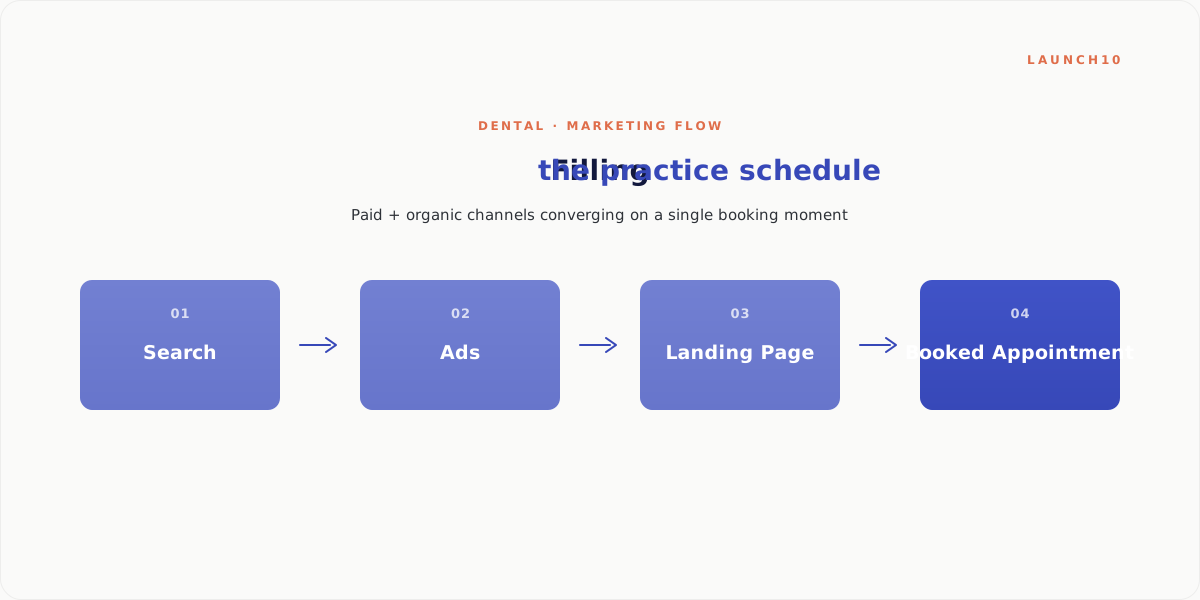
Why Dental Marketing Is Different from Other Local Services
Patient acquisition in dentistry is higher-stakes, higher-LTV, and more insurance-complicated than other local services — which changes every marketing decision.
Patient lifetime value in dentistry varies heavily by recall retention, procedure mix, and insurance participation — practices should calculate it from their own production data rather than rely on industry averages. That lifetime value supports acquisition costs that would bankrupt a typical home-services business. A plumber rarely justifies spending $300 on a single lead. A cosmetic dentist with a high-LTV patient mix often can.
Insurance networks add a second wrinkle. Patients filter by “who takes my plan” before they filter by distance or reviews. If you’re in-network with Delta Dental PPO, that’s a marketing asset — it needs to appear on your website, your GBP, and in your ad copy. If you’re out-of-network, your positioning work matters even more: you need to make the case for why switching or paying out-of-pocket is worth it.
Finally, the trust barrier is higher. People choose a dentist roughly every 5–10 years, and the decision involves anxiety, physical vulnerability, and often significant money. Marketing that rushes the decision — aggressive discounts, pressure tactics, generic stock photography — tends to underperform marketing that builds trust: real photos of the practice, specific clinical credentials, and patient stories in the patient’s own words.
The Channels That Actually Drive Dental Appointments
Most practices can get the bulk of their results by doing five things well. In rough order of payoff:
- Google Business Profile (GBP). A fully optimized GBP with recent photos, a complete services list, weekly posts, and substantial reviews does more for a typical practice than any other single asset. BrightLocal’s 2026 Local Consumer Review Survey finds 97% of consumers read reviews for local businesses, and GBP is where most “dentist near me” searches get decided.
- Google Ads for specific services. Paid search works best when it targets specific services (implants, Invisalign, emergency) rather than general “dentist.” Service-specific ads have higher intent, better quality scores, and allow dedicated landing pages that convert far better than generic traffic — Google Ads for small businesses covers the campaign fundamentals behind this.
- A website that actually converts. Not a portfolio of work, not a digital brochure — a site built to turn visitors into booked appointments. Every page needs a clear next step. Online booking has become table stakes; practices without it bleed leads to competitors who have it.
- Reviews and reputation management. Practices with 4.6+ star ratings and 100+ reviews routinely outperform those with 4.8 stars and 30 reviews. Volume signals trust. Build a systematic process for asking happy patients to leave a review — typically after the second or third visit, not the first.
- Referral systems. Most practices rely on passive word-of-mouth. Practices that systematize referrals — patient referral cards, post-visit emails with a shareable link, referral bonuses within ADA guidelines — consistently double their referral flow within 12 months.
Notice what’s not in the top five: Facebook advertising, Instagram content, direct mail, and SEO blog content. These can work — but they work as multipliers on the core five, not as substitutes for them.
Recall and reactivation campaigns targeting existing patients are usually more efficient than cold paid acquisition because they work against an audience that already has a relationship with the practice. Every practice should have a systematic recall program running in parallel with new-patient marketing.
Paid vs. Organic: Where to Put Each Dollar
For most dental practices, paid search fills the schedule this month and organic builds the practice value over five years. Both matter; neither replaces the other.
| Channel | Time to results | Best for |
|---|---|---|
| Google Ads (service-specific) | 2–4 weeks | Filling schedule, launching new services, emergency demand |
| Google Business Profile (organic) | 3–6 months | Compounding local visibility, capturing “near me” searches |
| SEO (service + location pages) | 6–12 months | Long-term flow of cases that don’t need Google Ads spend to repeat |
| Social content (Instagram, TikTok) | 6–12 months | Cosmetic, orthodontic, and pediatric practices where before/after is visual |
| Direct mail | 1–3 months | New practices in established neighborhoods; welcome-to-area campaigns |
Cost per new patient varies by market and channel; for dental Google Ads specifically, WordStream 2025 benchmarks show Dentists & Dental Services averaging $83.93 CPL.
The mistake most practices make is treating these as alternatives to each other. They compound. A practice that ranks well in GBP and also runs Google Ads will pay less per click — Google’s Quality Score rewards relevance, and GBP optimization signals relevance. The practices that spend the most per new patient are almost always the ones running paid without the organic foundation in place.
What a Converting Dental Landing Page Needs
A dental landing page converts when it answers one question fast: “Is this the right place for what I need, right now, at a price I can handle?”
Every field, photo, and paragraph should serve that answer. Most dental websites fail because they try to serve every audience — existing patients, new patients, insurance inquiries, career applicants — on every page.
Landing pages that book appointments share a predictable structure:
- A service-matched headline. If the ad says “Dental Implants in Phoenix,” the landing page headline says exactly that. Generic headlines like “Welcome to Smith Family Dental” burn ad spend by forcing visitors to figure out whether they’re in the right place.
- Transparent pricing or pricing ranges. Not every service needs a fixed price, but dodging the question entirely pushes price-conscious patients to competitors who are straightforward. “Starting at $X” or “Typically $X–$Y depending on complexity” is almost always better than “Call for a quote.”
- Social proof specific to the service. A cosmetic dentistry landing page should show cosmetic cases and cosmetic-patient reviews — not general practice testimonials about fillings.
- One primary call to action. Book online or call. Not both as equals. Decide which your practice converts better on and make it the dominant option.
- Insurance and financing answers. The two most common objections are “will my insurance cover this” and “can I afford this.” Address both above the fold.
- Real photos of the practice and team. Stock photography of generic dentists kills trust. Patients want to know who they’ll see and where they’ll go.
Dedicated landing pages consistently outperform homepages on paid traffic, though dental conversion rates vary widely by practice and service mix. Practices that run service-matched landing pages tuned for fast booking consistently end up toward the higher end, which translates to meaningful ad-efficiency gains every month.
If your ads are running but booking rates are low, the landing page is almost always the bottleneck. We covered this in detail in why connecting your ads and landing pages matters.
Measuring Dental Marketing ROI Correctly
Most practices measure activity — clicks, calls, impressions — instead of outcomes. Fix the tracking setup first, or every other decision is guesswork.
At minimum, every practice running paid marketing should be able to answer these three questions by Friday of any week:
- Cost per new patient, by channel. Not cost per lead — cost per patient who actually came in and paid for a service.
- Average case value, by patient source. Patients from Google Ads, GBP, and referrals tend to have different case profiles. Track them separately.
- Marketing payback period. How many months from first ad click to break-even on acquisition cost.
The tracking stack for this is straightforward but often missing. Conversion tracking on every form submission, call tracking numbers on ads and landing pages (not the same number as the main line), and a simple spreadsheet that reconciles monthly marketing spend against new-patient production. Practices that can’t answer the three questions above are flying blind — and almost always overspending on the wrong channels.
If you’ve never set up proper conversion tracking, start with our Google Ads conversion tracking setup guide. It walks through the mechanics step by step.
The Mistakes That Cost Dental Practices the Most
A short, honest list of the dental marketing choices that routinely waste money:
- Running Google Ads without landing pages. The most common and most expensive mistake. Ad traffic to homepages consistently wastes a substantial portion of budget versus traffic to service-matched landing pages.
- Targeting “dentist” as a keyword. Too broad, too expensive, too low-intent. Target services and “emergency” modifiers instead.
- Ignoring GBP. Free traffic with higher intent than almost anywhere else. Practices that don’t post weekly and respond to every review are leaving money on the table.
- Chasing new patients while losing existing ones. A patient who doesn’t hear from you for 18 months is a lost patient. Recall and reactivation campaigns targeting existing patients are usually more efficient than cold paid acquisition per dollar spent.
- Treating reviews as optional. Review volume matters as much as rating — BrightLocal’s 2026 Local Consumer Review Survey finds 97% of consumers read reviews for local businesses, and substantial review count at a strong rating consistently outperforms higher ratings on very few reviews.
For the Google-Ads-specific tactical playbook — keyword selection, emergency vs. planned-service campaign structure, and dental landing page essentials — see our companion guide on Google Ads for dentists.
Launch10 — Built for Dentists Who Want New Patients, Not Another Marketing Vendor
We built Launch10 for the dental practice owner — and the agencies serving them — whose actual job is patient care, not learning AdMap. People asked us for treatment-planning tools and patient management features constantly; we said no. Dentrix and Open Dental already do that work. We built the opposite: a single connected system that handles the landing page and the Google Ads campaign and the conversion tracking and the attribution dashboard.
Here’s what that gets a practice running paid search:
- Real ad cost data baked in, not guessed. Live keyword cost and competition for your zip code — so you aren’t bidding blind on “dentist near me” or “dental implants [city].”
- Pages built to win Quality Score. Sub-second LCP, mobile-first, zero bloat — the boring stuff Google rewards with cheaper clicks.
- Service-specific landing pages and Google Ads generated together (Invisalign, implants, emergency, family dentistry, cosmetic), on every plan including Starter.
- Click-to-appointment tracking out of the box. Call tracking, GCLID, form submissions, and dollar attribution so you can answer “cost per new patient” by campaign.
- Leads delivered wherever you already work. Dentrix, Open Dental, your front desk inbox — plus 5,000+ apps via Zapier.
This is not a patient-management platform. We run the marketing layer that books the chairs.
Best for: Dental practices running paid ads in any volume, plus the agencies and in-house marketers serving them.
Related reading
- Google Ads for dentists — the tactical campaign-build companion to this guide
- Why your Google Ads aren’t generating leads — diagnose the campaign before you blame the page
- Connecting landing pages to ads — what most practice websites get wrong on the ad-to-page handoff
Frequently asked questions
What's the best marketing channel for a dental practice?
How much should a dental practice spend on marketing?
What's a good cost per new patient for dental marketing?
Do I need a dedicated landing page for my dental ads?

Co-Founder & CEO, Launch10
Greg Hockenbrocht is the Co-Founder and CEO of Launch10. Before Launch10, he was on the executive leadership team at Fundera through its acquisition by NerdWallet, where he led Growth & New Ventures following the company's IPO. Through Illuminated Ventures and work with founders and business owners, he saw a need for Launch10 to help bring clarity, confidence, and ease to digital marketing.